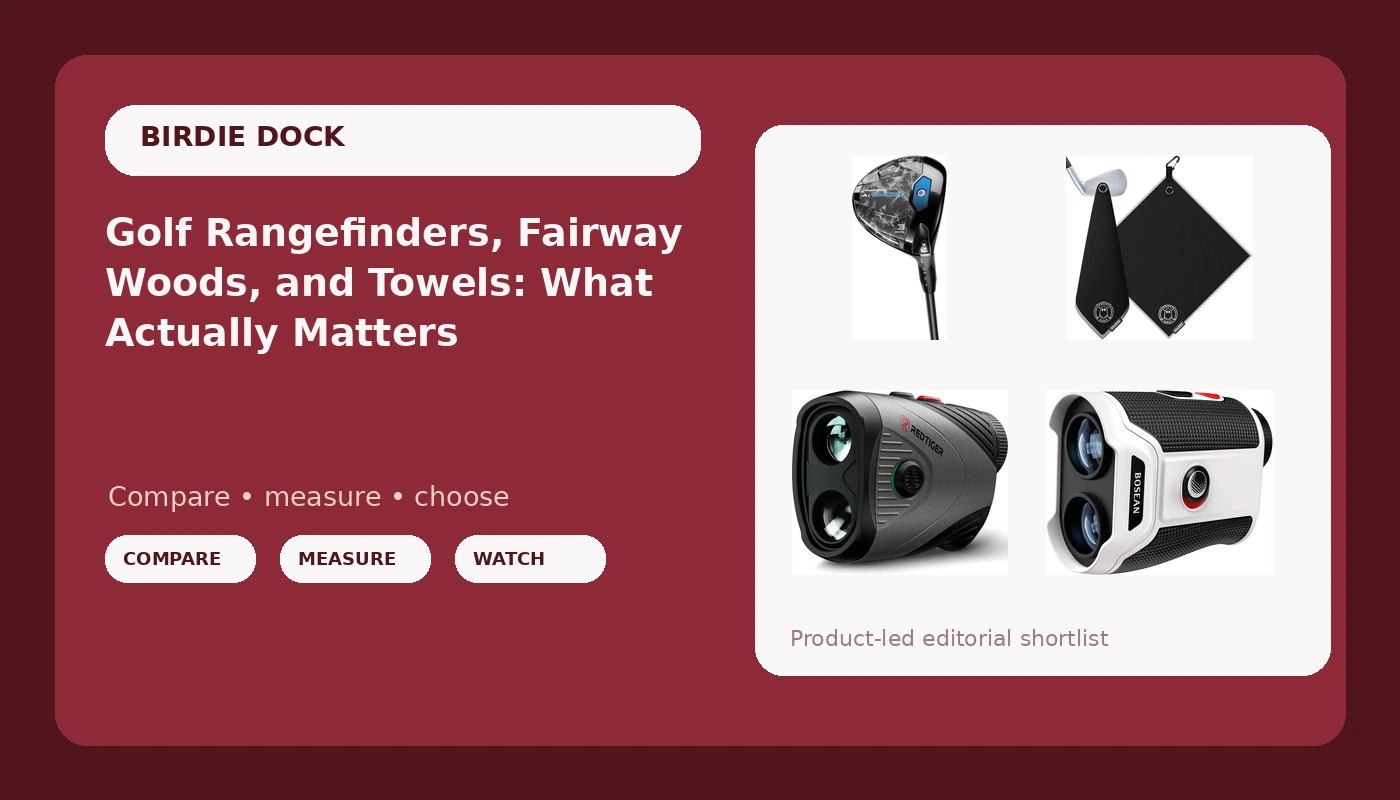
There are two kinds of golf purchases. The first is the club you think about for a month before you commit. The second is the gear you grab without thinking: the rangefinder you point at every flag, the towel you wipe a wedge with on the way to the green. A golf rangefinder and fairway wood decision gets all the attention, and the towel gets none, even though you touch the towel more often than any club in the bag. That imbalance is the problem. A product listing tells you what an item claims on day one. It does not tell you what it does on day 200, and it never tells you what breaks first. So here is a plain explainer of four items: two slope rangefinders, a Callaway fairway wood, and a magnetic microfiber towel. For each one, what it is actually for, which specs carry the weight, and how to decide whether the version in front of you is the version you need.
Related: How to Test a Golf Rangefinder's Pin Lock Before You Trust It →
Quick answer
Buy a rangefinder by how it locks the flag and how it gets power. Buy a fairway wood by the yardage gap it fills, not by the badge on the sole. Buy a towel by whether it stays attached to your bag. Between the two rangefinders here, the meaningful difference in the listings is power and feedback: one is listed as rechargeable with flagpole lock vibration, the other is listed with slope, a magnet, and 7x magnification. The fairway wood is the only club in the group, so it has to justify itself with distance coverage. The towel is the smallest item and the one you will handle most, which is why the magnetic attachment matters more than the fabric.
Four useful options
| Model | Best fit | What stands out |
|---|---|---|
| REDTIGER Golf Range Finder | Players who want slope and a magnet in a compact housing | Lists 7x magnification, a 1200-yard range, slope, and a magnetic body |
| 1200 Yds Golf Range Finder with Slope | Players who would rather recharge than hunt for coin-cell batteries | Lists rechargeable power, flagpole lock vibration, slope, a magnet, and 7x magnification |
| Callaway Golf Paradym Ai Smoke Max Fairway Wood | Filling the gap between your longest iron and your driver | A fairway wood from Callaway's Paradym Ai Smoke Max line, offered in multiple configurations |
| Ghost Golf Magnetic Towel | Keeping a towel on the bag or cart frame instead of in a pocket | Magnetic attachment with ultra-absorbent microfiber, per the listing |
Slope rangefinder with a magnet: REDTIGER Golf Range Finder
The spec that matters here is magnification, and 7x is the range where a flag stops being a smudge and starts being a target. More magnification is not automatically better. Past a certain point, hand shake gets amplified along with the flag, and a rangefinder you cannot hold steady is a rangefinder you stop carrying. Slope compensation is the second decision point. If you play any tournament golf, you need to know whether slope can be switched off, because a slope reading is not legal for a posted score under the rules most competitions use. A unit that always displays slope is a practice tool, not a tournament tool. The magnet answers the question of where the thing goes. Pocket carry means lint, keys, and re-focusing every time you pull it out. A magnetic body means it stays on the cart frame and gets grabbed without a search.
Rechargeable rangefinder with pin lock: 1200 Yds Golf Range Finder with Slope
Pin lock is the feature I would keep if I could only keep one. When you shoot a flag with trees behind it, a rangefinder without reliable lock will hand you the distance to a trunk and you will not know it until your ball is short or long. A vibration pulse is the cheapest possible fix for that: it tells you the unit committed to the flag rather than a branch. Rechargeable power is the second thing I look at, and it is a durability question as much as a convenience one. Coin-cell rangefinders die at the worst moment and the replacement is a specialty battery you have to remember to buy. A rechargeable unit moves that failure to a USB cable, which you already own. The trade is that a rechargeable battery is a sealed component. When it stops holding a charge, that is a bigger problem than swapping a battery.
The club in the group: Callaway Golf Paradym Ai Smoke Max Fairway Wood
A fairway wood earns its spot with a number, not a logo. If your longest iron carries about 185 and your driver carries about 240, you have a 55-yard hole in the bag, and that hole is where the ball goes on long par fours and reachable par fives. Before buying, write down the number you want the club to hit. Then check what you are actually ordering. Fairway wood listings vary by loft and by shaft, and a club that arrives in a loft or flex you did not intend is a return, not a fix. The cost-of-ownership question also applies to a club more than to any accessory here: a fairway wood is regrippable, reshaftable, and adjustable in ways a rangefinder is not, so it holds value differently. A grip change is cheap. A shaft change is not.
The accessory that stays on the bag: Ghost Golf Magnetic Towel
A towel is where the budget conversation gets honest, because the failure mode is never the fabric. It is the attachment. A clip that bends, a loop that frays, a string lanyard that snaps: that is what ends a towel's life, usually while you are standing on the fourteenth fairway with a muddy wedge. A magnetic attachment removes the weakest part of the assembly. It also removes the second-worst thing about carrying a towel, which is that you leave it on the fringe of the last green you chipped on. The fabric still matters. Clean grooves are free spin, and a wet microfiber side plus a dry side is the fastest way to get there without spitting on your club. But if you are choosing between two towels, choose the one whose attachment you believe will still be there in two years.
Prices and availability may change. Product images, names, and retailer links must be matched by verified ASIN. Do not state a current price, rating, stock status, or measured result without current evidence.
What a rangefinder actually has to do
Strip the branding away and a rangefinder has four jobs. It has to find the flag, tell you the distance to it, tell you whether the shot plays longer or shorter than the number, and survive being carried. Everything else is packaging.
Flag acquisition is the first job and the one most listings understate. Trees, bunker lips, and mounding all sit behind a pin, and a unit that grabs the wrong object will give you a confident, wrong number. That is why lock feedback matters so much. A visible reticle change or a vibration pulse tells you the reading is the flag and not the oak tree 20 yards behind it.
Slope is the second job. On an uphill approach, the raw number is not the number you play. Slope compensation adjusts for the elevation change. It is genuinely useful in a casual round and genuinely illegal in a posted one, so the practical question is not whether a unit has slope, it is whether you can turn slope off and know it is off.
Power is the third job. Rechargeable versus replaceable is a real fork in the road. Rechargeable means one cable and no specialty batteries. Replaceable means you can restore full capacity in thirty seconds, forever, as long as the battery type stays available.
Magnification is the fourth. Seven times is a common and practical figure. Enough to isolate a flag at distance, not so much that your pulse turns the image into a metronome.
How to judge gear before you commit
Durability is the spec that matters most and the one no listing prints. A product page describes day one. What you want to know is day 200, and the only way to reason about that without owning the item is to look at what wears first and what it costs to fix.
- Name the job the item does on your home course. A rangefinder on a course with no yardage markers is not a luxury. A towel on a walking round is a pocket problem, not a bag problem.
- Find the cheapest option that lists the same core spec. If a cheaper unit lists the same magnification, the same range, and the same lock feedback, the extra money is buying something other than the spec.
- Identify the first wear point. Battery door, lanyard, clip, grip, shaft adapter. Then ask what a replacement costs and whether you can do it yourself.
- Read the buried details before ordering. Loft, shaft flex, handedness, battery type, attachment style. These are the fields that turn a good purchase into a return.
- Re-check at 30 days and again at six months. That is when you know whether the thing earned its price, and it is when you decide whether to buy a second one or a replacement.
Practical guidance for a bag that holds up
- Decide on slope legality before you buy. If you post scores, confirm the unit can run without slope and that the setting is obvious.
- Treat lock feedback as a required feature, not a bonus. A number you cannot trust is worse than no number.
- Match the power source to your habits. If you never remember specialty batteries, buy rechargeable.
- Write down the yardage gap before you shop for a fairway wood, and confirm loft and shaft in the listing.
- Judge towels, brushes, and lanyards by the attachment first. That is the part that fails.
- Buy two of anything cheap that has a known wear point, so a snapped lanyard costs you nothing but a walk to the bag.
Which option should you choose?
Choose the REDTIGER Golf Range Finder when you want slope and 7x magnification in a unit that mounts magnetically to the cart instead of riding in your pocket. Choose the 1200 Yds Golf Range Finder with Slope when rechargeable power and flagpole lock vibration are the two features you care about most, and you would rather plug in than shop for batteries. Choose the Callaway Golf Paradym Ai Smoke Max Fairway Wood when you have a specific yardage hole between your longest iron and your driver, and you have confirmed the loft and shaft in the current listing. Choose the Ghost Golf Magnetic Towel when you want a towel that stays on the bag or cart frame and actually gets used instead of left on the fringe.
None of these listings is a durability test. The features above come from the product records, not from a season in a cart, and a magnetic attachment that holds on one bag frame may behave differently on another. Verify loft, shaft, handedness, battery type, and attachment style on the current listing before you order, and check back on any accessory after a few months of real rounds. That is the only durability data that counts.
The bottom line
Two rangefinders with the same magnification and range separate on power source and lock feedback, and those are the two specs that decide whether you keep carrying the thing. A fairway wood is the only purchase here that has to answer to a number, so name the number before you shop. The towel is the smallest line item and the one you touch most, which is why its attachment deserves more scrutiny than its fabric. Buy the spec you will actually use, skip the spec you will not, and re-evaluate everything after a season rather than after a week.