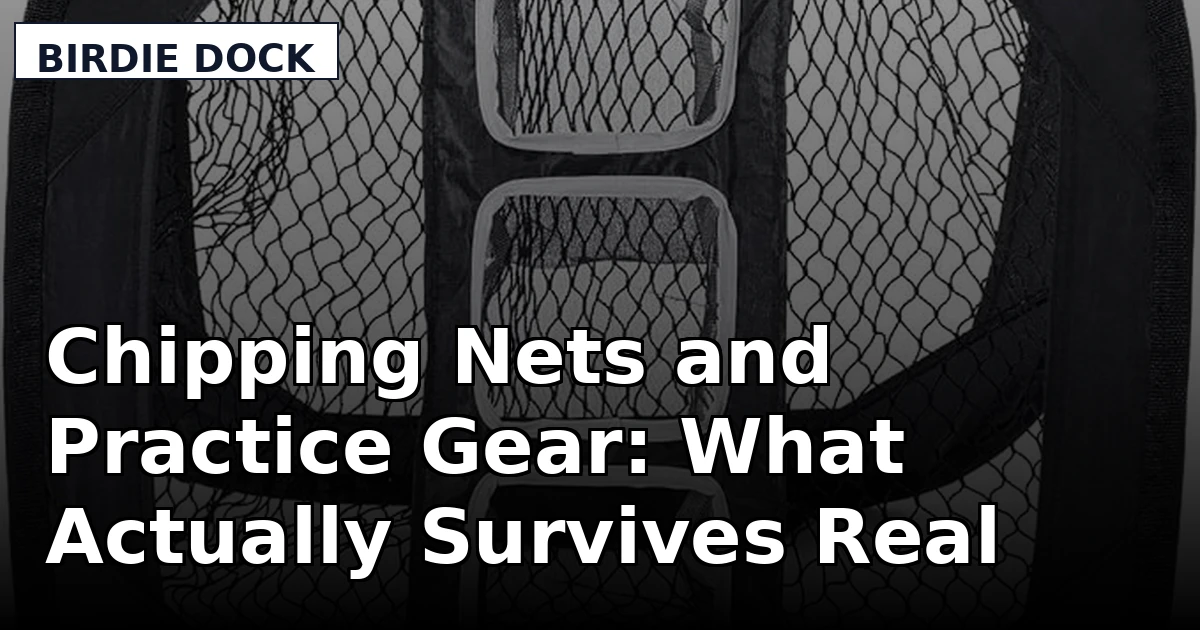
Most golfers do not need another $500 club. They need a way to hit fifty chips a week without driving to a range, grips that are not slick and shiny, and a shirt that does not feel like a wet towel by the ninth hole. That unglamorous side of the bag is where golf chipping practice nets, regripping supplies, and a decent moisture-wicking polo quietly do more for your score than another headcover. This explainer covers four specific products across three jobs: two chipping nets at very different price points, a do-it-yourself grip repair kit, and a budget polo, along with how to tell which one belongs in your cart and which one can wait.
Related: How to Build a Backyard Practice Setup Without Wrecking Your Lawn →
Quick answer
For most players the sensible order of spending is: a net you will actually use, then fresh grips, then a shirt that handles heat. The GoSports Chipster Pop-Up is the low-commitment entry point if the net needs to fold away. The Callaway Chip-Shot is the step up if the target will live outdoors and take full wedges. The CHAMPKEY kit makes sense for anyone already paying a shop to regrip, and the Obla polo is a straightforward dry-fit option for hot practice sessions. None of these four products fixes a swing. They are cheap infrastructure that makes practice and play more comfortable.
Four useful options
| Model | Best fit | What stands out |
|---|---|---|
| GoSports Chipster Pop-Up Golf Chipping Practice Net | Small yards, garages, indoor reps | Pop-up design built for indoor and outdoor chipping practice |
| Callaway Chip-Shot Golf Chipping Net | A net that stays set up outside | Branded chipping target from an established golf company |
| CHAMPKEY Deluxe Grip Repair Kit | Players who regrip their own clubs | Includes hook knife, tape, solvent, and a rubber vise clamp |
| Obla Men's Golf Polo Shirts | Hot-weather rounds and practice | Dry-fit, moisture-wicking, lightweight collared shirt |
The low-commitment practice net: GoSports Chipster Pop-Up Golf Chipping Practice Net
The case for a pop-up net is behavioral, not technical. If setup takes two minutes, you chip for ten minutes on a Tuesday evening. If setup takes twenty minutes, you chip on Saturday and then not again until next Saturday. A folding design removes the excuse, which is why this style of net is the one most golfers should buy first. The trade-off is that lighter, folding nets are generally the least tolerant of full-speed wedges and long-term UV exposure, so plan on storing it out of the sun and treating it as a chipping and pitching tool rather than a driver cage.
The sturdier target: Callaway Chip-Shot Golf Chipping Net
The honest question with any branded practice aid is what the name on the box buys you. In this case it buys a target designed by a golf company rather than a generic sporting goods pop-up, and typically a more substantial frame than a folding net. That matters if the net is going to sit outside through a season of weather and absorb hundreds of wedges. It does not matter much if you are hitting twenty chips a week in a garage. Buy the sturdier target when the net has a permanent home; buy the folding one when it does not.
The do-it-yourself regrip kit: CHAMPKEY Deluxe Grip Repair Kit
This is the product on the list that pays for itself fastest, and it is also the one most likely to sit in a drawer unused. Regripping is not difficult, but it is a solvent-and-blade job that rewards preparation: work outdoors or in a ventilated space, protect the floor, and have a hook blade you trust. The rubber vise clamp is the piece people underestimate, because holding a club steady while you slide a grip on is the difference between a clean install and a twisted mess. If you have been paying a shop per club, the math on doing thirteen clubs at home is easy to run yourself.
The hot-weather polo: Obla Men's Golf Polo Shirts
Apparel is the least technical purchase here and the most personal. A dry-fit polo does one measurable thing: it moves sweat away from your skin and dries faster than cotton, which matters most on a ninety-five degree afternoon in the desert or a humid range session. What it does not do is change your ball flight. The practical trap with performance knits is sizing, because a lot of them are cut closer to the body than a standard cotton polo. Read the size chart before ordering, and if you are between sizes, think about how you want the shirt to sit at the top of the backswing.
Prices and availability may change. Product images, names, and retailer links must be matched by verified ASIN. Do not state a current price, rating, stock status, or measured result without current evidence.
What a chipping net can and cannot do
A chipping net trains two things well and one thing poorly. It trains contact, because you can hit forty chips in ten minutes and feel exactly where on the face the ball came off. It trains trajectory control, because a target with a defined opening forces you to land the ball in a specific window rather than just somewhere forward. What it trains poorly is green reading, rollout on real turf, and the lie variability you get on an actual course. A net is a repetition machine, not a short game simulator.
That distinction should drive what you buy. If your problem is chunking and thinning chips, any net that catches the ball and gives you fast feedback works. If your problem is judging how a ball releases on a fast green, no net solves it, and your money is better spent on a round at a course with a practice green. Being honest about which problem you have prevents you from buying a more expensive net to fix something a net cannot fix.
What the money buys across nets, grips, and fabric
Three different pricing logics are in play in this article. A net is priced on material, frame, and size: a folding pop-up uses less material and fewer parts than a framed target, so it costs less, and it also has a shorter lifespan outdoors. Grips and grip kits are priced on consumables, and the consumable cost is what recurs, since tape and solvent run out long before the tools wear out. Apparel is priced on fabric, cut, and branding, and the functional gap between a budget dry-fit polo and a premium one is far narrower than the price gap suggests.
That last point is worth dwelling on, because golf apparel markups are steep. What you are paying extra for in a premium polo is usually fabric hand-feel, fit consistency across sizes, and the logo. Moisture-wicking performance itself is not exclusive to expensive shirts. The same logic applies to nets: a brand name does not automatically mean better netting, though it often means a frame that stands up better to being left outside.
- Count how many chips you would realistically hit in a week. Under fifty favors a folding net; over a hundred favors a fixed frame.
- Decide where the net lives. Indoors or packed away points to pop-up; a permanent outdoor corner points to a sturdier target.
- Check your grips by feel, not by memory. Slick, shiny, or hard rubber means it is time, and a full set of clubs makes a kit worthwhile.
- Price the alternative. Compare the cost of a kit plus your time against what your local shop charges per club.
- Buy the cheapest item that solves the actual problem, then spend the savings on greens fees.
Practical guidance for nets, grips, and polos
- Back a chipping net with something solid. A net hung loosely against a fence absorbs energy far better than one on a bare frame.
- Match the ball to the net. Check what ball speed the net is rated for before you hit full wedges into it, and use foam or limited-flight balls when in doubt.
- Look at the netting and the mat separately. On bundled practice setups the mat is usually the first thing to wear through.
- Regrip in batches. Once solvent is open and the vise is clamped, doing the whole set takes barely longer than doing one club.
- Ventilate and cover the floor. Grip solvent is a mess indoors and the smell lingers, so do the job in a garage or driveway.
- Read the polo size chart and check the return window, because dry-fit knits run closer to the body than cotton.
Which option should you choose?
Choose the GoSports Chipster Pop-Up Golf Chipping Practice Net when you practice in a small space, want to pack the net away after each session, and your priority is hitting more chips per week. Choose the Callaway Chip-Shot Golf Chipping Net when the net will live outdoors in one spot and you want a more permanent target to walk up to. Choose the CHAMPKEY Deluxe Grip Repair Kit when your grips are due and you would rather do the work at home than pay per club. Choose the Obla Men's Golf Polo Shirt when you need an affordable moisture-wicking shirt for hot practice days and you have checked the sizing.
One caveat applies to all four: the product listings describe intent and construction, not measured durability. How long a net survives depends on your ball speed, where you set it up, and whether it stays in the sun. How long a grip lasts depends on how often you play and whether you keep them clean. Those variables live with you, not with the listing.
The bottom line
If you are deciding where to start, start with the net, because it changes how often you practice, and frequency beats equipment every time. Add the grip kit when your grips are due, since clean, tacky grips are the cheapest performance gain in golf and doing it yourself lowers the cost further. The polo is a comfort purchase, and a budget dry-fit shirt covers the functional job well. Buy in that order, keep the receipts, and judge each item after a season rather than after a week.