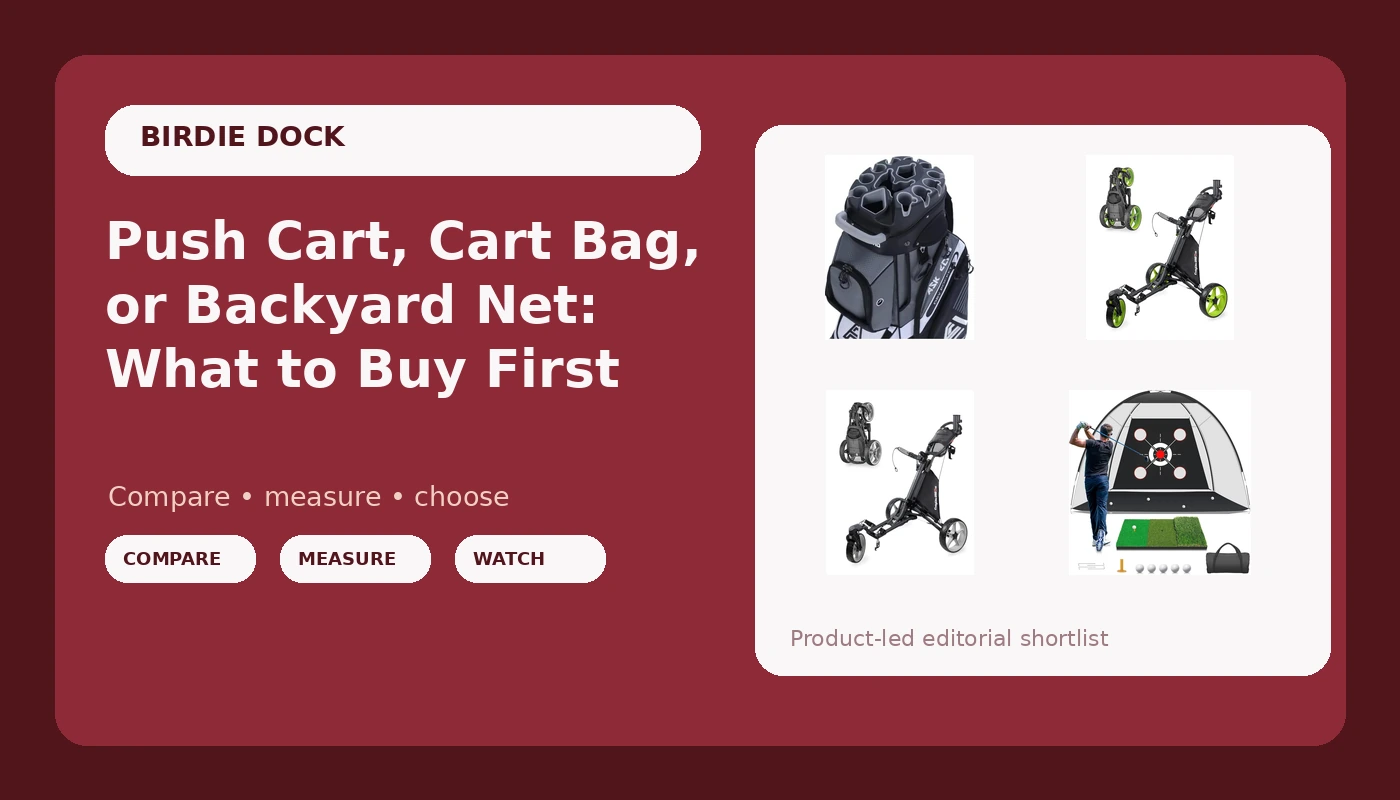
Most golfers buy gear in the wrong order. They spend on a driver that promises ten more yards, then keep carrying a bag that leaves their shoulders sore by the 14th hole, then wonder why their swing falls apart on the back nine. The unglamorous purchases do more for a normal player: a golf push cart that takes the load off your back, a cart bag that keeps fourteen clubs from turning into a tangled mess, and a practice net that lets you hit real balls in the yard instead of driving to a range. This is an explainer on those three jobs, why they matter more than another club, and how to tell which version of each is worth your money.
Related: How to Build a Backyard Practice Setup That Survives Real Golf Balls →
Quick answer
Buy the walking solution first, the organization solution second, and the practice solution third. A three-wheel push cart with a swivel front wheel and one-click folding removes the physical tax of carrying, which is the single biggest quality-of-life change a weekend golfer can make. A cart bag with a full-length 14-way divider keeps every club separated and quiet, and it sits more securely on a cart than a stand bag. A backyard net with a practice mat gives you swing reps without a tee time. Two of the products below carry the same name and the same stated feature list, so treat them as one cart offered under two listings rather than two different carts.
4 useful options
| Model | Best fit | What stands out |
|---|---|---|
| Caddytek CaddyLite ONE-Swivel V8 Golf Push Cart | Walkers who want to stop carrying | One-click folding, 360 degree swivel front wheel, adjustable handle, cooler basket, umbrella and drink holder |
| Caddytek CaddyLite ONE-Swivel V8 Golf Push Cart (second listing) | The same cart, alternate listing | Identical stated name and feature list, so availability is the deciding factor |
| ASK ECHO T-Lock Golf Cart Bag | Riders and push cart users who want a stable, organized bag | Quiet 14-way full-length divider and T-Lock cart mounting |
| Golf Net with Practice Mat, 10x7FT | Backyard driving and chipping reps | Listed as a 10x7 ft net with target mat, practice mat, and balls |
Best for walkers: Caddytek CaddyLite ONE-Swivel V8 Golf Push Cart
The swivel front wheel is the feature worth understanding, because it is the difference between a cart you enjoy pushing and one you fight. On a fixed front wheel, changing direction means pressing down on the handle to lift the front end and pivot, which is fine on flat fairways and annoying everywhere else. A swivel wheel turns the way a shopping cart does, so you steer with one hand and keep your other hand free for a drink, a rangefinder, or a scorecard. One-click folding matters for a less obvious reason: the cart you use is the cart that is easy to get out of the car. If setup takes four minutes of unfolding and wrestling with a latch, you will carry instead. The trade-offs are real but manageable. A push cart is one more thing to store, it needs its wheels wiped down after wet rounds, and it does not help you on a course that requires carts. For the majority of public courses where walking is allowed, though, it converts a physical grind into a pleasant walk, and it does that for less than the price of a single new wedge.
Alternate listing: Caddytek CaddyLite ONE-Swivel V8 Golf Push Cart
When two Amazon listings carry the exact same product name and the exact same feature description, they are almost always the same product split into variants, which usually means colorway, packaging, or bundled accessories. What that means practically is simple: you are not choosing between two carts, you are choosing between two listings of one cart, and the deciding factors are availability and which seller you would rather deal with. Do not read one listing as an upgraded model. If you want to compare them properly, open both pages, confirm the stated feature list still matches what is written above, and pick the one that is actually in stock when you are ready to buy. The spec that matters is unchanged either way: swivel front wheel, one-click fold, adjustable handle, three wheels. That combination is what makes the cart worth owning, not the listing page it came from.
Best for riders and pushers: ASK ECHO T-Lock Golf Cart Bag
There are two divider specs that separate a good cart bag from an irritating one, and this bag addresses both. The first is the number of slots: fourteen ways means one club per slot, so you are not pulling three irons out to find your 8 iron. The second, and the one people ignore until they own a cheap bag, is whether the dividers run the full length of the bag. On a partial divider, the tubes stop partway down and the grips and shafts tangle below, which is exactly where the club chatter comes from. Full-length dividers keep shafts separated all the way down, which is what makes a bag quiet when you walk. The T-Lock mounting matters if you ride or push, because a bag that shifts and rotates on the cart is a bag you re-seat every third hole. The honest trade-off is weight and shape: a cart bag with a full-length divider is bulkier and heavier than a stand bag, and it is not the bag you want to carry. If you have committed to pushing or riding, that trade is worth making.
Best for backyard reps: Golf Net with Practice Mat, 10x7FT
A net is the cheapest way to convert free time into golf reps, and the bundle here covers the parts people forget. The 10x7 foot size is the relevant number: a net that is too small turns every slightly fat shot into a miss that sails past the frame, and a 10 foot wide, 7 foot tall face gives you room for a driver swing without standing two feet from the netting. The practice mat matters more than the net for most players, because hitting off bare ground or thin turf is how you learn to flip at the ball, and a mat at least gives you a consistent lie. The target mat gives you something to aim at, which is the difference between practice and mindless swinging. The caveat is that netting and mats are wear items. Anything rated for a ball speed above what you actually produce is fine, and anything below it will fail, so check the stated rating against your driver ball speed before you buy, and consider hanging an extra layer of padding behind the netting and adding a thicker stance mat over time. Buy it as a starter kit, not as a permanent structure.
Prices and availability may change. Product images, names, and retailer links are matched to verified product records. Do not state a current price, rating, stock status, or measured result without current evidence.
What actually changes your game at this price point
Three things improve a normal golfer's scores, and none of them is a new club. The first is energy management. Carrying a bag for four hours loads your shoulders, lower back, and legs, and the effect shows up late in the round, which is exactly when the expensive shots happen. Pushing a cart moves that load onto wheels, and a three-wheel cart with a swivel front wheel also removes the awkward lifting motion of a two-wheel pull cart, which is worse for your back than carrying in some cases. The second is setup consistency. A bag with a full-length 14-way divider gives every club a fixed home, so your pre-shot routine does not start with untangling grips. Small friction like that adds up over eighteen holes. The third is volume of practice. Twenty swings in your backyard on a Tuesday night beats one range session on Saturday, and it costs nothing once the net is up. None of these three purchases adds a single yard of distance. All three make the game easier to play more often, and playing more often is the only reliable way to get better.
How to judge durability before you buy
Durability is the spec nobody prints on the box, and it is the one that decides whether you got value. Start with the parts that move. On a push cart, that is the folding mechanism, the wheel axles, and the front wheel assembly. Look for metal where plastic would be cheaper, and read the one and two star reviews specifically for words like "cracked," "snapped," and "stripped," because moving parts fail in predictable ways. On a bag, the failure points are the zippers, the divider fabric, and the strap attachment points. A 14-way full-length divider is a durability feature as much as an organization feature, since separated shafts cannot rub the finish off each other. On a net, the netting is the consumable. Check the stated ball speed rating against your real driver speed, and plan on the netting being the first thing to go, followed by the mat surface. If a replacement mat or a roll of netting costs a fraction of the whole kit, that is a good sign, because it means the item is repairable rather than disposable.
- Decide whether you are solving walking, organization, or practice first, and buy only that.
- For a cart, confirm three wheels, a swivel front wheel, and a folding mechanism you can operate with one hand.
- For a bag, confirm the divider is 14-way and full length, not just 14-way at the top.
- For a net, compare the stated ball speed rating to your actual driver ball speed, and size the face for a driver swing.
- Read the one and two star reviews for the specific part that fails, then decide if you can fix or replace it cheaply.
Practical guidance for setting up your gear
- Wipe cart wheels and axles after wet rounds, since grit in the axle is what kills a cheap cart first.
- Store the push cart folded and dry, not leaning against a garage wall with weight on the front wheel.
- Empty your bag's side pockets before a round so the T-Lock or cart straps can seat the bag flat.
- Set the net up with the target mat a couple of feet in front of the netting so you can see strike quality, not just contact.
- Put a thicker stance mat over the included mat if you practice more than a bucket at a time, and add padding behind the netting.
- Log your practice: count balls hit per session and note when the netting or mat starts to show wear.
Which option should you choose?
Choose the Caddytek CaddyLite ONE-Swivel V8 Golf Push Cart when you walk and carrying is the thing that wears you down by the 14th hole. Choose the ASK ECHO T-Lock Golf Cart Bag when you ride or push and want fourteen clubs separated full length, quiet on the move, and stable on a cart. Choose the Golf Net with Practice Mat, 10x7FT when your biggest barrier is not gear at all but the drive to the range, and you want to hit real balls at home. The second Caddytek listing is not a fourth choice: it is the same cart under a different listing, so compare availability and pick one, not both.
One caveat on evidence. Nothing here is a claim about measured durability, ball speed, or fit, and no current prices or ratings are quoted, because those change and because a product page is not a test result. Treat the stated specs as the starting point, verify them against the live listing before you buy, and judge the gear on what it does after a season rather than what the description promises on day one.
The bottom line
The order of operations is what matters. If you walk, a three-wheel push cart with a swivel front wheel and one-click folding buys you more comfort per dollar than any club in the bag. If you push or ride, a cart bag with a genuine full-length 14-way divider keeps your clubs organized and quiet, and it stays put on the cart. If your problem is reps rather than rounds, a 10x7 net with a mat and a target turns your backyard into a place you can actually practice. Buy the one that fixes your current bottleneck, use it for a season, and then decide whether you need the next thing.