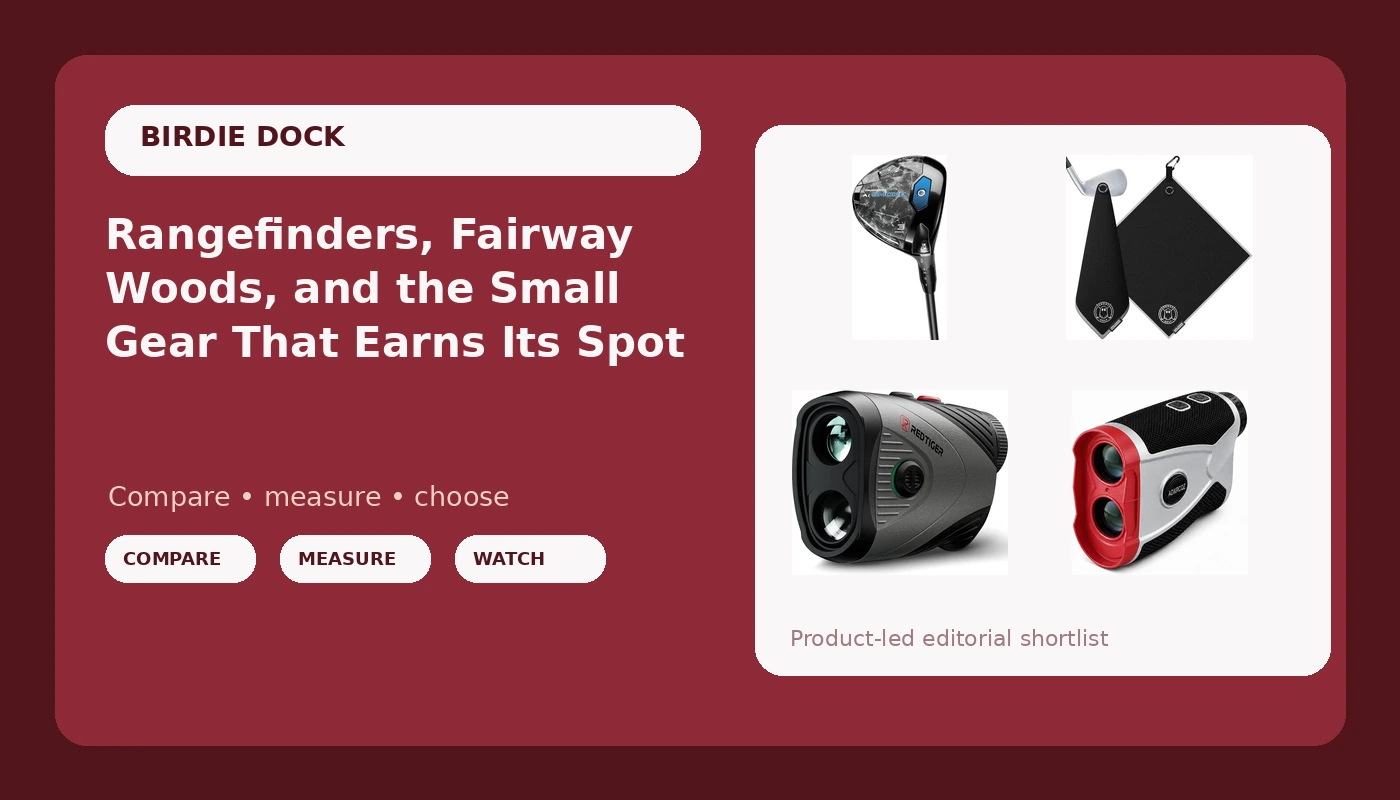
Most golf bags get assembled backwards. The club with the biggest advertising budget goes in first, and the tool that tells you which club to hit stays in the cart. If you are sorting out a golf rangefinder and fairway wood purchase in the same season, the useful question is not which product is best. It is which one changes the most shots for the money you are actually spending. I spent six years behind a fitting counter before I moved to a desk job, and the pattern never changed: the club used forty times a round beats the club used twice, and a real number in your hand beats a guess in your head.
Related: How a Slope Switch Rangefinder Works →
Quick answer
If you do not already carry a rangefinder, buy one before you buy anything else. Both rangefinders here do the same basic job with 7X magnification and a rated 1200-yard range, so the real decision is how you want to handle slope. The fairway wood is the larger commitment and the larger swing change, which makes it the second purchase, not the first. The towel is the cheapest item in this group and the one you will touch on nearly every hole.
Four useful options
| Model | Best fit | What stands out |
|---|---|---|
| Callaway Golf Paradym Ai Smoke Max Fairway Wood | Replacing an aging 3-wood or a long iron you cannot launch | A current Callaway fairway wood in the Paradym Ai Smoke family |
| REDTIGER Golf Range Finder, 7X Magnification 1200 Yards with Slope, Magnetic | A first rangefinder, or a second one for a travel bag | 7X magnification, 1200-yard rated range, slope, and a magnetic body |
| Golf Rangefinder with Slope Switch, 7X Magnification, 1200 Yards | Players who want slope they can shut off | A dedicated slope switch, 7X magnification, and a 1200-yard rated range |
| Ghost Golf Magnetic Towel, Greenside, Ultra-Absorbent Microfiber Golf Towel | Anyone currently wiping irons on a pant leg | Magnetic attachment and ultra-absorbent microfiber |
The club upgrade: Callaway Golf Paradym Ai Smoke Max Fairway Wood
A fairway wood earns its spot in the bag when it covers a yardage your irons cannot reach and your driver should not be hitting. That is the entire job description. Everything else, the finish, the crown graphics, the badge on the sole, is decoration.
At the counter I watched players buy a 3-wood because the number sounded aggressive, then leave it in the bag all season because they could not get it off the ground from the fairway. In most current fairway families, the Max badge signals the more forgiving shape rather than the compact tour shape, and this listing sits in Callaway's Paradym Ai Smoke family, so it is aimed at the player who wants help rather than a blade-like profile. If you already hit your 5-wood well, the honest move is to check whether a 7-wood or a hybrid closes your gap with less effort.
One more thing before you commit. Ask what the club costs to live with. A regrip is cheap and a reshaft is not, and a fairway wood with an odd hosel or a glued shaft limits your options later. I have rebuilt enough clubs to know that cost of ownership belongs in the decision, not in the surprise column three months after checkout.
The value pick: REDTIGER Golf Range Finder, 7X Magnification 1200 Yards with Slope, Magnetic
This is the category where the gap between price and performance has closed the most in the last few years. A rangefinder has one core job: send a laser out, catch the flag, and give you a number you trust. Magnification and rated range tell you what the unit is built to do, and the rest is lock speed, how steady it feels in your hands, and whether the battery situation is annoying.
Slope is the feature that divides players. On a course with real elevation change, an adjusted distance is genuinely useful, because a 150-yard shot uphill is not a 150-yard club. The catch is that slope readings are not permitted in competition under the rules most players follow, so a unit that cannot switch slope off becomes a practice-only tool. If you play any organized golf at all, that single detail should drive your decision more than magnification does.
Magnetic mounting is the underrated spec here. A rangefinder that sticks to the cart frame instead of riding loose in a cup holder is a rangefinder that does not end up on the grass behind the 14th tee. I have watched more than one player drive away from a $300 unit without noticing.
The slope-switch option: Golf Rangefinder with Slope Switch, 7X Magnification, 1200 Yards
The difference between this unit and the one above comes down to how slope gets handled. A physical switch is a simple thing, and simple things survive. You flip it, the slope reading stops, and nobody has to wonder whether you are using a conforming mode. That matters if you play club events, qualifiers, or anything where a competitor might ask.
Here is the trade-off worth naming. A dedicated switch adds a moving part, and moving parts are what fail first on any piece of golf gear. That does not make it a bad choice, it makes it a choice you should make deliberately. If you play strictly casual rounds on a flat course, slope readings may be a feature you never use, and you can save the decision entirely. If you play a hilly home course and also tee it up in tournaments, the switch is the whole point.
The rest of the package is familiar: 7X magnification is enough to pick a flag out of a treeline at normal playing distances, and a 1200-yard rated range is well beyond anything you will need on a golf course. Nobody is ranging a green from 1,100 yards. What matters is whether the unit locks the pin consistently and holds that number when you pull it out of the bag on the next hole.
Prices and availability may change. Product images, names, and retailer links are matched to verified listings. No current price, rating, stock status, or measured result is stated here without current evidence.
The small essential: Ghost Golf Magnetic Towel, Greenside, Ultra-Absorbent Microfiber Golf Towel
Clean grooves are free spin. That is not a slogan, it is the reason a wedge that has been wiped between shots behaves differently from one that has not. A wet, dirty face and a wet, dirty ball kill the friction that makes a wedge check up, and most players never connect the two.
A magnetic towel solves the part of this that actually fails, which is access. Towels that hang from a clip get lost, and towels stuffed in a side pocket never come out. A magnetic attachment on a cart frame or a club face keeps the towel where your hand already is, which means you use it. The microfiber is doing the work on moisture and grit, and the magnetic format is what makes the whole thing convenient enough to become a habit instead of a resolution.
I will say the same thing about this towel that I say about every cheap item you carry around a course: buy it knowing it is a consumable. Lanyards and clips are the parts that break first, and the string lanyards on inexpensive accessories are the usual culprit. If the attachment fails in a season, you are out the cost of a sleeve of balls, not a round of golf. That math is fine.
What a fairway wood actually does for your bag
Gapping is the whole conversation. If your driver carries 230 and your 5-iron carries 170, you have a hole in the bag between those numbers, and a fairway wood is one way to fill it. A hybrid is another. The right answer depends on your angle of attack and how much you trust a long, shallow club off the turf.
Loft selection matters more than the name on the sole. A 15-degree 3-wood is a tee club for a lot of mid-handicap players and a headache from the fairway. A 5-wood or 7-wood at higher loft launches more easily, lands softer, and produces a more useful number for approach shots. If you are honest with yourself about which one you will actually hit, the higher-lofted club usually wins.
Shaft flex is the spec nobody asks about and everybody feels. The old fitter who trained me said it a hundred times: flex matters more than the logo on the head. A fairway wood with the wrong shaft will feel dead no matter what it cost, and a mid-price club with the right shaft will feel better than the premium one next to it.
How slope and pin lock change your yardage decisions
Slope gives you an adjusted distance that accounts for elevation change between you and the target. Uphill plays longer, downhill plays shorter, and the number on the screen is the club you should actually pull. It is one of the few features in golf gear that directly answers a question you were already asking.
Pin lock is the vibration or visual confirmation that the laser caught the flag rather than a tree behind it. That feedback is the difference between a number you trust and a number you second-guess. On a unit with a 1200-yard rated range, the flag at 160 yards is not a challenge for the hardware. Locking the right object is the challenge, and pin lock is how you know it happened.
Here is a workable order for deciding:
- Decide whether you play any competition golf at all, because that determines whether you need slope you can switch off.
- Check that the unit mounts somewhere secure, ideally magnetically, so it does not live loose in a cart cup holder.
- Confirm the magnification and rated range are enough for your home course, which for almost every player means 6X or 7X and far less than 1200 yards.
- Read what owners say about battery type and battery life, since proprietary batteries are a long-term annoyance and rechargeable units are not.
- Only after all of that, compare what each unit costs, and ask what the more expensive option does that the cheaper one does not.
Practical guidance
- Buy the rangefinder before the fairway wood if you currently pace off sprinkler heads, because the number helps every club in the bag.
- Write your real carry distances down after a few rounds. Knowing your 7-iron flies 155 rather than 150 is worth more than any single club upgrade.
- If you play tournaments, treat a switchable slope mode as a requirement and not a nice-to-have.
- Check the cost of a regrip and a reshaft before buying any club, and factor that into what the club really costs you.
- Replace the small stuff when it breaks rather than upgrading it. Towels, brushes, and lanyards are consumables, and the cheap version usually does the job.
Which option should you choose?
Choose the REDTIGER Golf Range Finder, 7X Magnification 1200 Yards with Slope, Magnetic when you want slope and magnetic mounting at the lowest entry point in this group. Choose the Golf Rangefinder with Slope Switch, 7X Magnification, 1200 Yards when you need a slope reading you can turn off with a physical switch for tournament play. Choose the Callaway Golf Paradym Ai Smoke Max Fairway Wood when you have a genuine yardage gap at the top of your bag and the swing to launch a fairway wood off the turf. Choose the Ghost Golf Magnetic Towel, Greenside, Ultra-Absorbent Microfiber Golf Towel when you want the cheapest meaningful upgrade to your routine.
One caveat on all of it. Magnification and rated range come from the listings, not from my own testing, and I will not pretend otherwise. Lock speed, how steady a unit feels in your hands, and how a fairway wood performs off a tight lie are the things you learn from months of rounds and from owners who post updates long after the unboxing. Treat the specs as the starting point and the durability reports as the verdict.
The bottom line
The best gear purchase is the one that answers a question you keep asking on the course. For most players that is a yardage, and a rangefinder with 7X magnification and a 1200-yard rated range covers it, with slope as the deciding feature. A fairway wood is a bigger commitment that only pays off if it fills a real gap, and the towel is the cheapest way to stop costing yourself spin on every wedge shot. Spend where the shots are, not where the marketing is.