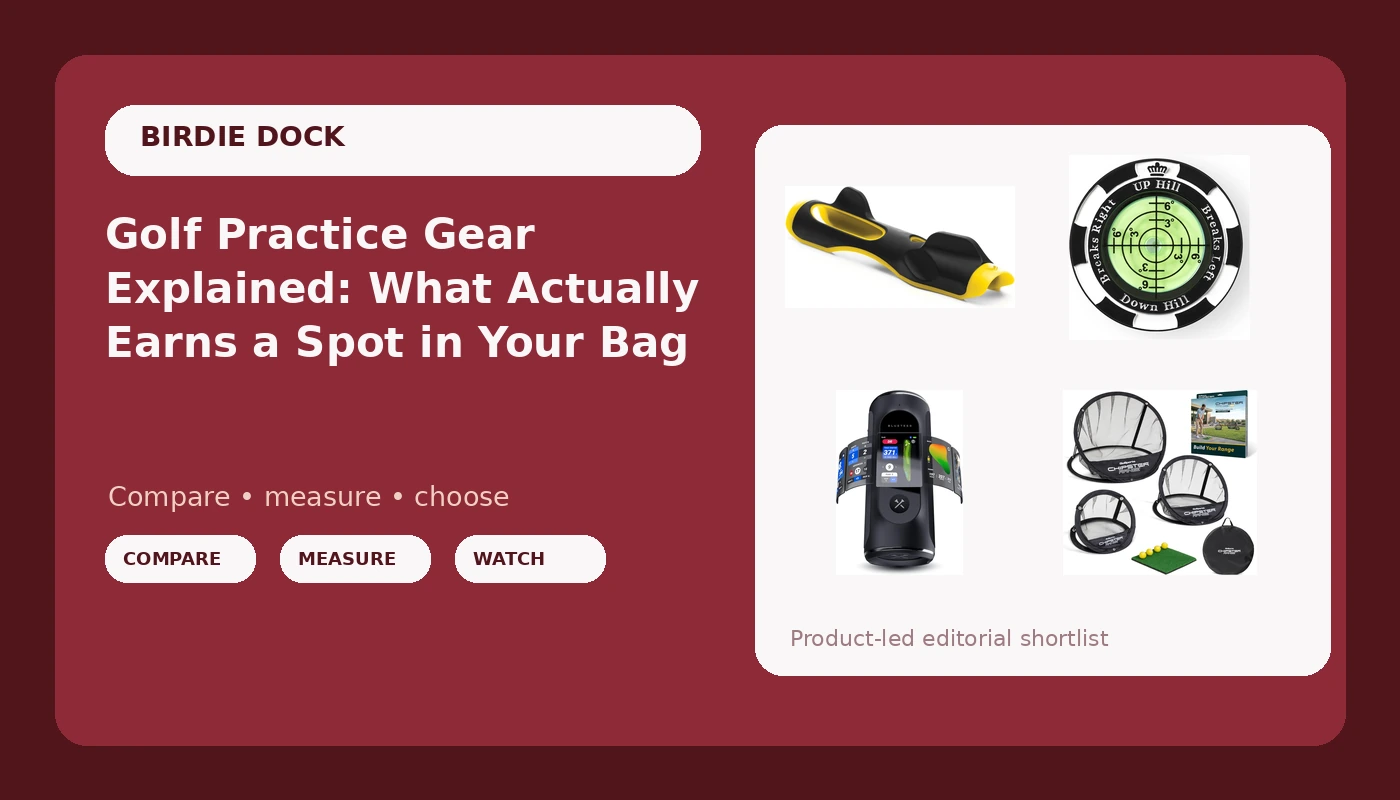
Most golfers I know do not need another club in the bag. They need a way to practice that fits the hours they actually have, whether that is twenty minutes in the garage after work or a rushed warm-up before a Saturday tee time. That is the job golf practice gear is supposed to do: a chipping net you can set up in the driveway, a grip trainer that lives on your 7-iron, a green reader in your pocket, a GPS speaker clipped to the cart. The category is also stuffed with plastic gadgets that promise tour-level improvement and end up sitting in a trunk by July.
I spent six years behind the counter of a big-box golf store, fitting clubs and doing repairs, and I watched the same cycle repeat. A player buys a training aid, uses it twice, and assumes the problem is them. Usually the tool was asked to do something it cannot do. A grip trainer builds feel; it does not diagnose a swing path. A chipping net gives you reps; it does not tell you why the ball came off the toe. A GPS unit tells you how far the flag is; it does not tell you which club to hit.
The four items below cover four different jobs, and they do not overlap much. Here is what each one is actually for, and how to decide which one deserves your money first.
Related: How to Dial In Wedge Distances Without a Launch Monitor →
Quick answer
Match the tool to the miss. If your yardages and hazard numbers are guesswork, an on-course GPS unit solves a problem you hit every single round. If your short game gets zero practice between rounds, a chipping net produces reps at home. If the club feels wrong in your hands at address, a grip trainer works on the foundation. If you bleed strokes on the greens, a green reader is the smallest and cheapest piece to test. All four are information or repetition tools; none of them substitutes for practice that includes feedback.
Four useful options
| Model | Best fit | What stands out |
|---|---|---|
| Blue Tees Golf Player Pro GPS Speaker | On-course yardages plus audio | Course library of 42,000+, hazard distances, magnetic mount, IP67 waterproof rating |
| GoSports Chipster Range PRO Golf Chipping Nets | Backyard or garage chipping reps | Includes a hitting mat and four foam balls, built for indoor and outdoor use |
| SKLZ Golf Grip Trainer | Grip position and address feel | Attaches to standard grips from driver to wedge, right-handed |
| SlopeMaster ProGreen Reader | Reading slope on the greens | A ball marker with a green reading aid built into it |
On-course information: Blue Tees Golf Player Pro GPS Speaker
A GPS unit and a rangefinder answer different questions, and it is worth being honest about which one you actually need. A rangefinder gives you a number to the flag you shoot. A GPS unit gives you front, middle, and back, plus hazards like a creek or a bunker lip, and it does it without you pulling anything out of the bag or holding still. For most players inside 100 yards, front and back matter more than a laser number to a pin tucked three paces off the edge.
The trade-offs are real. This is a battery device, so it needs charging on a schedule, and it pairs with a course library rather than reading whatever is in front of you. If you play a lot of courses that are not mapped well, or you want a number to a specific tree, a laser is still the tool. If you want one less thing to do while walking to your ball, this class of device earns its place. Check the current listing for the course coverage in your area before you commit.
At-home reps: GoSports Chipster Range PRO Golf Chipping Nets
The thing to understand about a chipping net is that the ball it comes with decides what you learn. Foam balls are safe indoors, they protect drywall, and they let you groove a motion and a landing spot. They do not give you the feedback of a real golf ball off a wedge face, because there is no compression, no spin, and no real turf interaction. That is not a flaw in this product; it is the nature of foam.
If you want real-ball feedback, you need a setup that can take real balls, which usually means a sturdier net, a proper mat, and some padding at the impact point. That is a different purchase and a different budget. My advice for anyone buying a chipping net is the same regardless of brand: check what the netting is rated for, look at whether the target area is reinforced, and expect the mat to be the first thing that wears out. Buy it for reps and for the habit of practicing, not as a substitute for range time.
Grip and setup: SKLZ Golf Grip Trainer
I have regripped a lot of clubs, and I can tell you that grip is the cheapest thing to change and the hardest thing to change. A trainer like this does not teach you a swing. What it does is give your hands a reference point, so that when you take it off and address the ball, you have something to compare against. That is genuinely useful for players who have never had anyone check their grip, which is most of them.
Two caveats. First, this one is right-handed, so lefties need to look elsewhere. Second, a grip trainer can only reinforce a position; it cannot tell you whether your grip matches your ball flight. If you are fighting a hook or a slice, the grip is often part of the story, but so is face angle and path. Use the trainer to build a neutral, repeatable feel, then get eyes on your ball flight, or better, a couple of lessons, before you decide the grip was the whole problem.
Greenside detail: SlopeMaster ProGreen Reader
Reading greens is the part of golf where feel and information disagree the most. Your feet tell you one thing, your eyes tell you another, and the ball tells you the truth. A slope aid gives you a second opinion on the tilt, which is helpful on unfamiliar greens and on putts where you genuinely cannot feel the break.
What it will not do is tell you how much the putt breaks, because that depends on speed, grain, and how the green drains. Treat it as one input, not an answer. Also worth checking: some formats and local rules restrict green-reading aids, so confirm what is allowed in the events you play before you lean on it. As a marker that happens to carry a slope reference, it is a low-risk addition to the bag.
Prices and availability may change. Product images, names, and retailer links must be matched by verified ASIN. Do not state a current price, rating, stock status, or measured result without current evidence.
What practice gear can and cannot fix
Every training aid on the market falls into one of two buckets: tools that give you information, and tools that give you reps. Information tools, like a GPS unit or a green reader, answer a question you cannot answer yourself. Reps tools, like a chipping net or a grip trainer, let you repeat a motion more often than you otherwise would. Neither bucket fixes a fault you have not identified.
That distinction matters because it sets your expectations. If you buy a chipping net and hit forty chips a night for a month, you will get better at chipping, because you are practicing. If you buy a GPS unit and still guess your club, nothing changes, because the information was never the problem. Before you buy anything, write down the last three shots that cost you strokes. If the answer is "I did not know my number," buy information. If the answer is "I never practice that shot," buy reps.
What to check before you buy
Durability is the spec that decides whether a practice aid was worth it, and it is almost never on the box. I keep a simple log for anything I use regularly: how often I use it, how it is stored, and what broke first. That habit has saved me more money than any sale ever has.
- Identify the shot or number that actually costs you strokes, and buy for that specific problem.
- Check what the product is rated to handle, especially nets and mats, and compare that to how you will really use it.
- Look at what wears out first and whether the replacement part is cheap or available at all.
- Confirm it fits your storage and setup reality, including ceiling height, garage space, and whether it needs a phone or a charge.
- Decide whether you want information or repetition, because those are different purchases and only one of them matches your problem.
Practical guidance
- Set the practice aid up where you already spend time, not in a closet you have to dig through.
- Practice with a target, not just a net. Aim at something specific so the reps have a purpose.
- If a tool needs charging, put it on the charger after every round so it is ready when you are.
- Keep the small stuff, markers, trainers, and brushes, in a pocket or pouch you actually use, or it will stay in the bag.
- Give any new aid a month of regular use before you judge it, and track what you paid against how often you used it.
Which option should you choose?
Choose the Blue Tees Golf Player Pro GPS Speaker when your on-course problem is not knowing front, middle, and back or where the hazards start, and you want that information plus audio from one device. Choose the GoSports Chipster Range PRO Golf Chipping Nets when your short game never gets practice because getting to a range is the bottleneck, and a portable target with a mat and foam balls removes that excuse. Choose the SKLZ Golf Grip Trainer when nobody has ever checked your grip and the club feels different in your hands every time you set up. Choose the SlopeMaster ProGreen Reader when you want a second read on slope from something that also marks your ball.
One caveat applies to all four: none of these listings comes with a measured, independent durability record. My own rule is to treat manufacturer specs as claims until I have used a product for a season, and to check the current listing for the exact configuration, course coverage, or material before buying.
The bottom line
Golf practice gear is not a shortcut, and the honest framing is that most of it buys you either information or repetitions, not skill. A GPS speaker replaces guesswork on the course. A chipping net replaces the excuse that you cannot practice at home. A grip trainer replaces a bad habit at address with a repeatable feel. A green reader gives your eyes a second opinion. Pick the one that matches the shot you actually lose strokes on, use it consistently for a month, and then judge it on whether it survived and whether you kept using it. That test, not the marketing copy, is what tells you if it was worth the money.