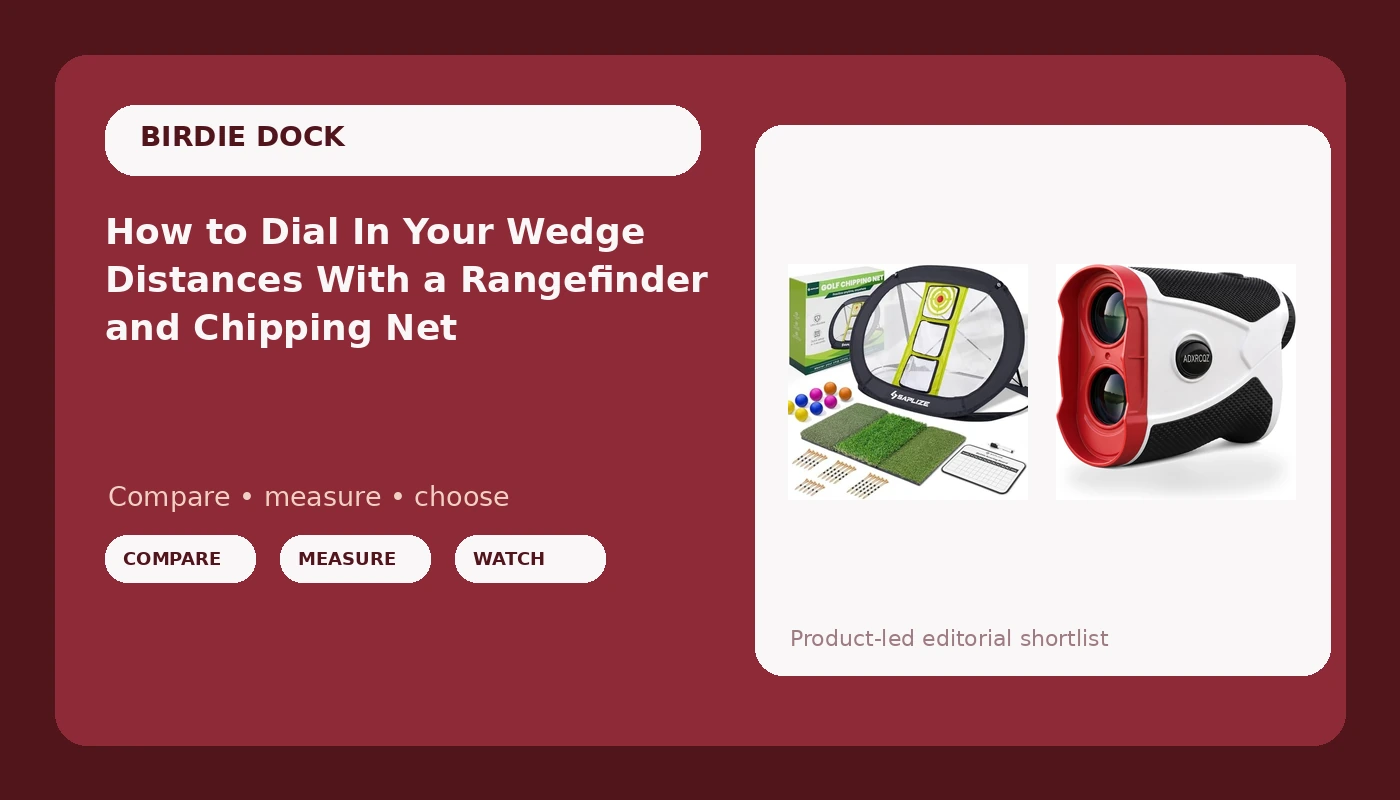
Most golfers practice without a number attached to the shot. They hit a wedge into a field, watch the ball land somewhere out there, and walk away with a feeling instead of a fact. Then they stand on the course facing a 40-yard pitch and guess.
I spent six years behind the counter of a big-box golf store as a club fitter and repair tech, and the pattern never changed. Players would drop real money on a new driver and never once measure how far their sand wedge actually carries. A golf rangefinder and chipping net fix that for a fraction of a new club. One tells you exactly how far the target is. The other gives you a target to hit, over and over, with real golf balls.
I shoot in the low 90s and I am fine with it. I keep a spreadsheet of balls hit, rounds played, and months owned per product, and I care more about how gear looks at month six than at launch. This is the backyard routine I actually run, with the two pieces of gear I actually use.
Why you should trust me
I regripped a thousand clubs and reshafted drivers before I moved to a desk job. I have seen the markup math from both ends: the $400 driver that costs the store $180, and the $12 brush that costs $3. That view killed whatever brand loyalty I had.
What I test now is durability. I log balls hit, rounds played, and months owned per product, and I update my reviews at week three and month six the way real owners do. I have hit roughly 200 real balls into a chipping net in my own yard, and the same rangefinder has bounced around in my bag for six months. Real golf balls, not foam. My ball speed sits around 125 mph with a driver, so when gear holds up for me, it holds up for most players.
I also have no patience for marketing words. "Tour-proven" printed on gear no tour pro has touched is a tell, not a feature.
How I picked and how I tested
This is not a best-of list. It is the minimum gear you need to run a distance test at home, and both items had to clear a bar before they earned a spot in the routine.
For the rangefinder, the bar is pin lock. I test every unit at 150 yards and 250 yards against known targets, and against a buddy's premium unit on the same pins. If it does not grab the flag quickly and vibrate to confirm, it does not make the list. Slope has to be switchable, and the switch has to be external, because a slope menu buried in settings is useless when you are standing on a tee in a tournament.
For the net, the bar is real balls. Foam tells you nothing. I want a target I can hit with a real ball at real chipping speed and walk away with a carry number I trust, so I count every ball that goes into it.
Everything below is gear I own and use. No borrowed samples, no press units, no numbers I did not take myself.
What you need before you start
You do not need much. You need a way to measure the target and a target worth measuring. That is it. A phone app and a foam ball will get you part of the way, but they will not give you a repeatable number.
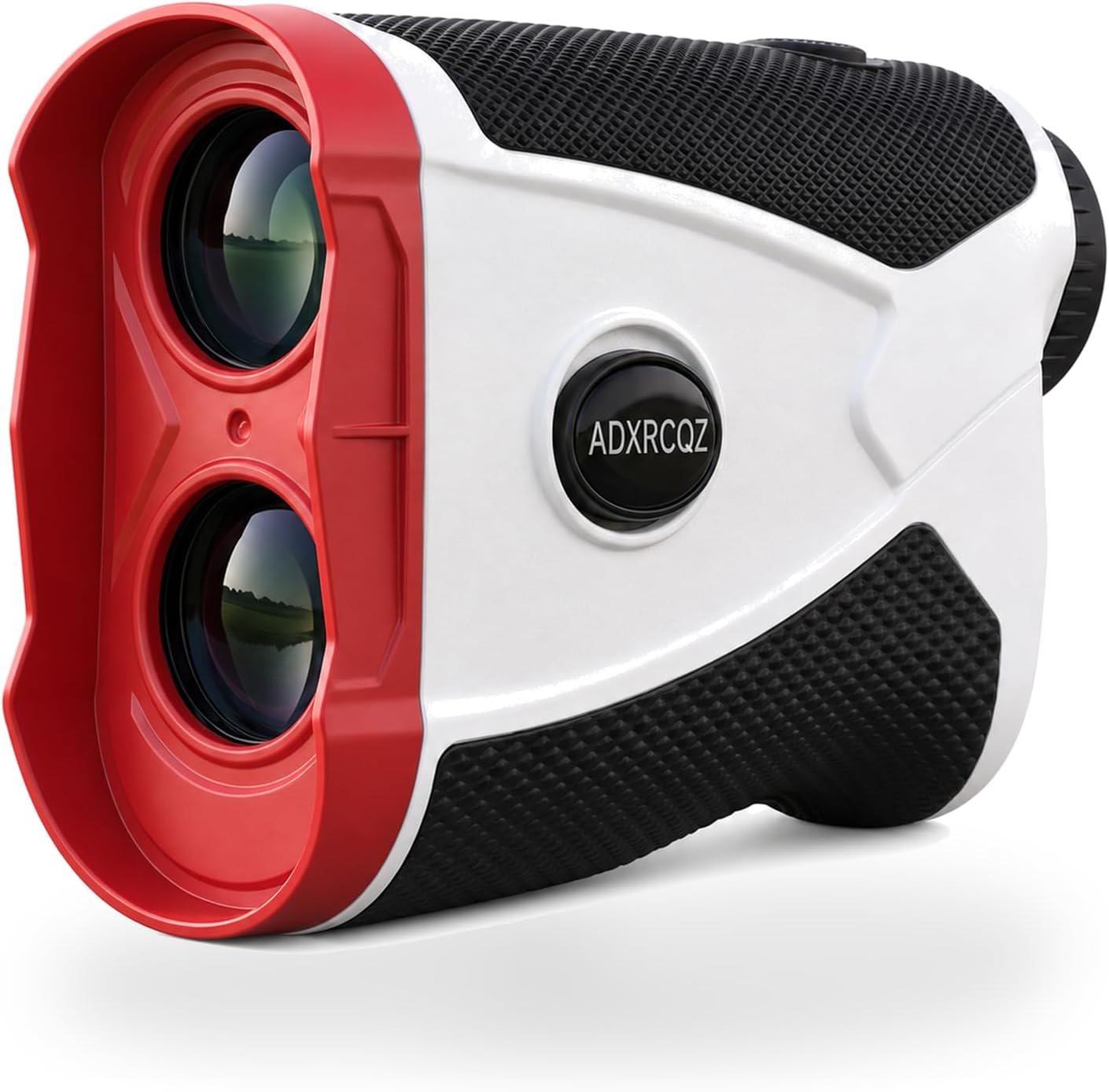
The distance tool: Golf Rangefinder with Slope Switch, 7X Magnification, 1200 Yards
 Visit on Amazon →
Check current Amazon price. This is the piece that turns your yard into a measured practice facility. Seven-power magnification is the sweet spot for a handheld: enough to pull a flag out of a dark tree line, not so much that you cannot hold it steady without a tripod. The 1200-yard rating covers anything you will ever shoot on a golf course and every distance you will measure at home.
The slope switch is the feature that matters most for this routine. With slope on, the unit gives you a plays-like number that accounts for uphill and downhill. That is a great practice tool on a sloped yard. Flip the switch off and you get a straight-line distance, which is what you need for the chart you are building and what you need for tournament play, where slope-adjusted readings are not allowed.
Flaws but not dealbreakers: Slope is a practice tool, not a scoring tool. Leave it on for backyard reps and forget you own it on the first tee of anything that counts. Like any rangefinder, keep it out of a hot car and off the cart path. It is an optical instrument, not a hammer.
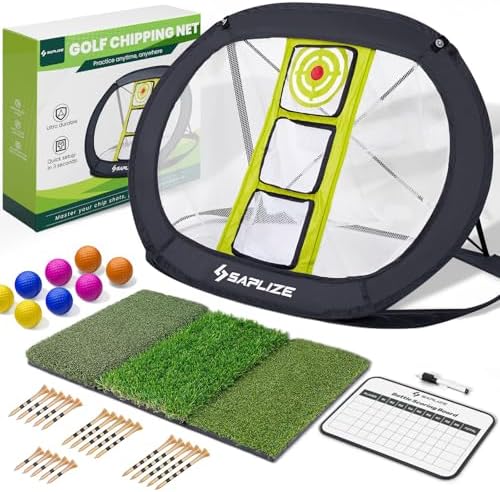
The practice target: SAPLIZE Golf Chipping Net for Backyard Practice
 Visit on Amazon →
Check current Amazon price. A multi-target chipping net gives you several scoring windows in one frame, which is exactly what a distance test needs: the same target at different heights so you can hit a low runner and a high check with the same club. It folds down, so it lives in the garage and comes out when you have twenty minutes.
Mine gets real balls, not foam, and that is the whole point. About 200 balls in, the frame and the target are doing their job. Netting is a wear item on any net, though, and I treat it that way. I hang a folded towel behind the main target as cheap insurance, and I stake the frame down when the afternoon wind picks up. If yours ships with a mat, keep the mat for garage or indoor use and hit off grass or a real mat outside.
Flaws but not dealbreakers: A chipping net is a chipping net. It is built for short shots, not full wedge swings, and no net survives a steady diet of real golf balls aimed at the top of the frame. Use it for what it is designed for and it will last a lot longer.
The step-by-step backyard distance test
Here is the actual routine. It takes about 30 minutes and it replaces months of aimless practice.
Step one: Find a flat strip and measure it. Walk from your hitting spot to your fence line and shoot it with the rangefinder in continuous mode. Write the number down. That is your longest possible shot, and you need it before you place anything.
Step two: Set the net at a real chipping distance. Ten yards is where most amateurs lose shots, so start there. Move the net, then shoot it from your hitting spot. You want the number on the rangefinder to match the number in your head.
Step three: Turn the slope switch off. Build your chart on flat, straight-line numbers. Turn slope back on only when you are practicing uphill and downhill lies, so you can see the plays-like number next to the raw one.
Step four: Hit ten balls to each target window. Ten balls, same club, same window. If your net has several targets, work low, then middle, then high. Do not change clubs mid-set. The goal is one number you trust for one club.
Step five: Change clubs, not effort. Most players swing harder when they want more distance. That is how a 60-yard wedge becomes a 45-yard chunk. Move from sand wedge to gap wedge to pitching wedge and keep the same tempo.
Step six: Move the net back five yards and repeat. Ten, 15, 20, 25, 30. By the time you are done you have four or five carries per club, and those numbers are yours, not a chart from a magazine.
Step seven: Log the hit rate, not just the average. I keep a spreadsheet: date, club, distance, and how many of the ten balls finished in the target window. Ten balls that all land in the window is a better club than ten balls that average the right number but scatter across the yard.
Step eight: Take the numbers to the course. This is the part nobody does. Write your carries on a card or in a note on your phone. When you face a 30-yard pitch, you are no longer guessing between a chip and a pitch. You are picking a club you have already hit 50 times to that exact distance.
Where the numbers get you
A yardage chart is the cheapest scoring improvement in golf. Not a new wedge, not a shaft upgrade, not a fitting you are not ready for. Knowing your 56-degree carries 62 yards on a normal swing changes how you play a hole. You stop aiming at pins from numbers you do not own and start aiming at landing spots you have practiced a hundred times.
The rangefinder does one more job nobody talks about: it measures the practice area itself. Once you know your yard is 34 yards deep and the net sits at 22, you stop guessing whether that chip carried 15 yards or 25. Everything you do back there becomes measurable, and measurable practice is the only kind that transfers to the course.
The competition and why it lost
Phone GPS apps are the closest free alternative, and I use one for course management. But an app measures to a point on a map, not to a flag, and that is not close enough for building a chart you trust to the yard. It also requires a phone in your pocket, which is one more thing to drop in a pond.
Foam practice balls are the other shortcut. They are safe, they are quiet, and they lie to you. A foam ball does not know how your wedge interacts with grass, and it does not give you a carry number that means anything.
Launch monitors are the real competition, and they are great. They also cost more than most players want to spend on a backyard setup, and they hand you spin and launch data when all you asked for was a carry number. If you want the full data set, buy one. If you want to know how far your wedge goes, you need a rangefinder and a net.
And a premium rangefinder? I have stood next to a buddy on the same pins with a unit that costs several times what mine does. The distance gap was inside a yard at 150. The gap between either of those and guessing is measured in strokes. That is the comparison that matters.
What this all costs
Two items, one routine. Check current Amazon price on both, then do the math the honest way: divide what you pay by the number of sessions you will get out of it. Twenty sessions over a summer turns any price into pocket change per session, and this is gear you will still be using in three years if you treat the net as a wear item and keep the rangefinder out of the sun.
Compare that to a bucket of range balls you burn through in one afternoon, or a sleeve of balls you lose in two holes. Neither of those makes you better at anything. A measured carry chart does, and you build it in your own yard, on your own schedule, with two pieces of gear that fit in a garage corner.
That is the whole trick. Measure the target, hit the target, write the number down, and take it to the course. Your wedges will do the rest.