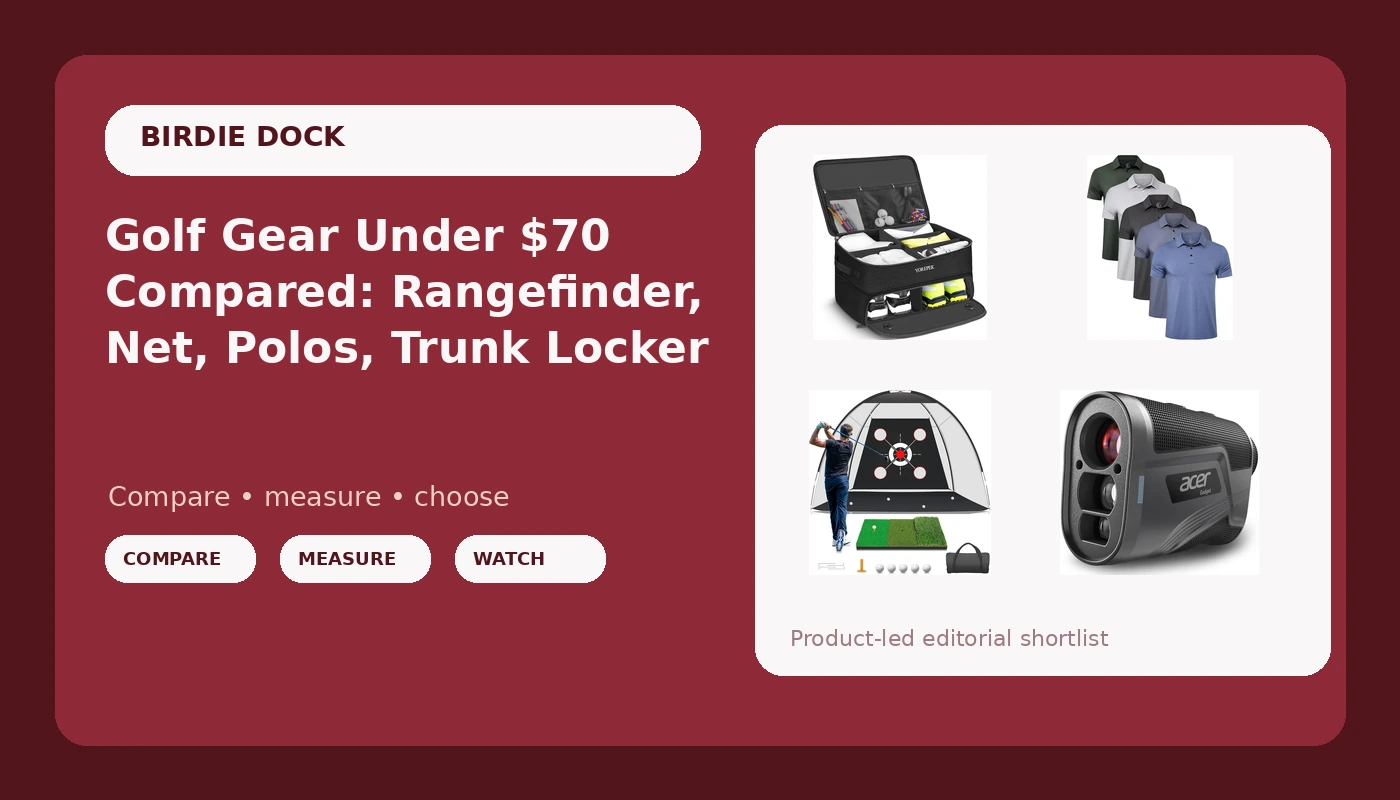
Four golf purchases, four completely different problems, and one shared question: does the cheaper version do the job? That is the whole premise of this golf gear under $70 comparison. I spent six years behind a big-box golf counter fitting clubs and fixing them, and the lesson from that job was never that premium gear is bad. It was that most of the money in a golf bag goes toward things that do not lower a score or survive any longer. A rangefinder, a backyard practice net, a five-pack of polos, and a trunk organizer have almost nothing in common except this: each one solves a real annoyance, and each one has a price tier above it that is happy to take your money instead. So I judge all four the same way I judge a wedge. What is the job? What breaks first? What does the next tier up actually add?
If you buy only one thing here, buy the rangefinder. Distance is the one number that changes on every shot, and a slope-capable unit with a pin lock is the closest thing to a free stroke in the golf aisle. The net comes second, because practice reps beat new clubs every time. The polos and the trunk organizer are comfort purchases, and I mean that with affection, since comfort is what keeps you playing in September when it is still 104 degrees in Scottsdale.
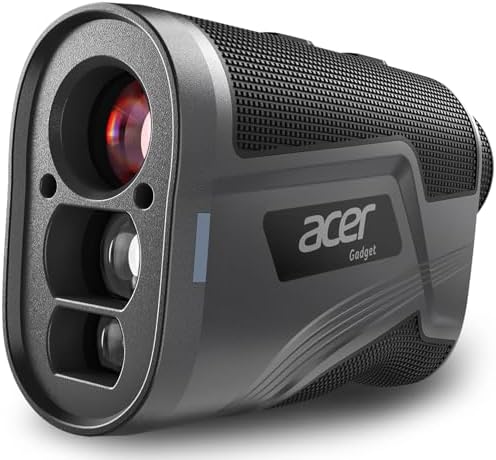
Acer Gadget Golf Rangefinder with Slope On/Off
Slope switch keeps it legal for tournament play, pin lock vibration confirms the flag, rechargeable and magnetic
Only helps if you already know your stock yardages, and 6X glass is good but not the brightest at this tier
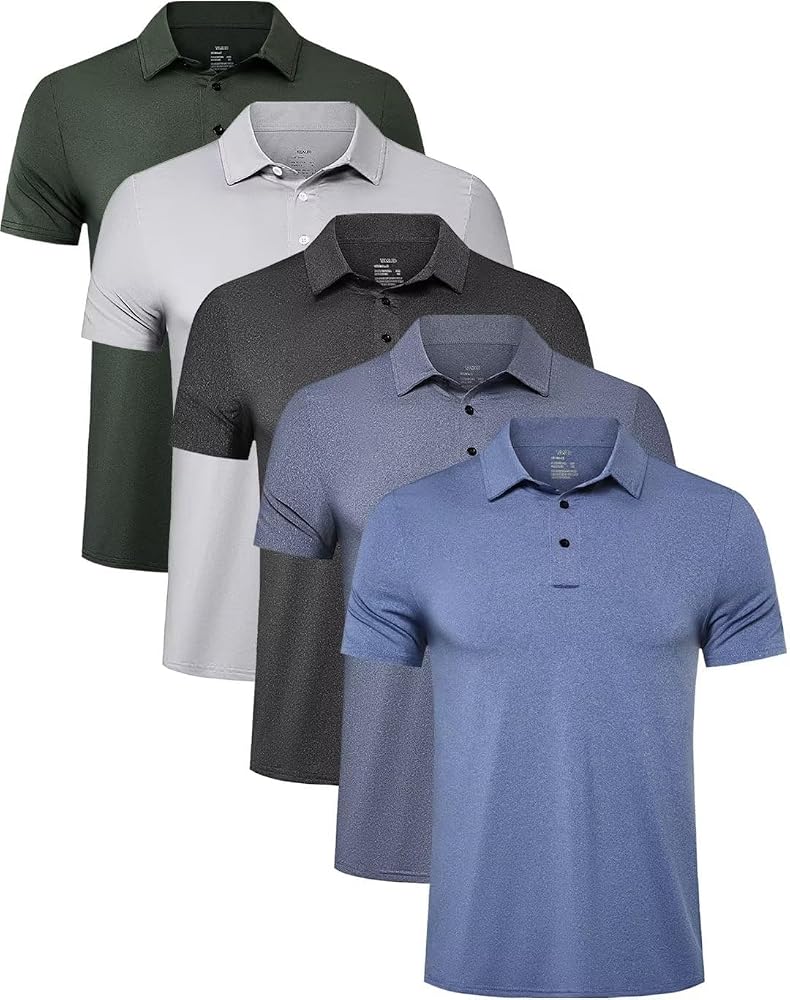
5 Pack Men's Polo Shirts Short Sleeve Golf T Shirt
Five shirts in one order, tagless collar, moisture wicking, quick dry, sun protection built in
Fit is the wild card in any multi-pack, and lightweight performance fabric rarely survives many seasons of heavy washing
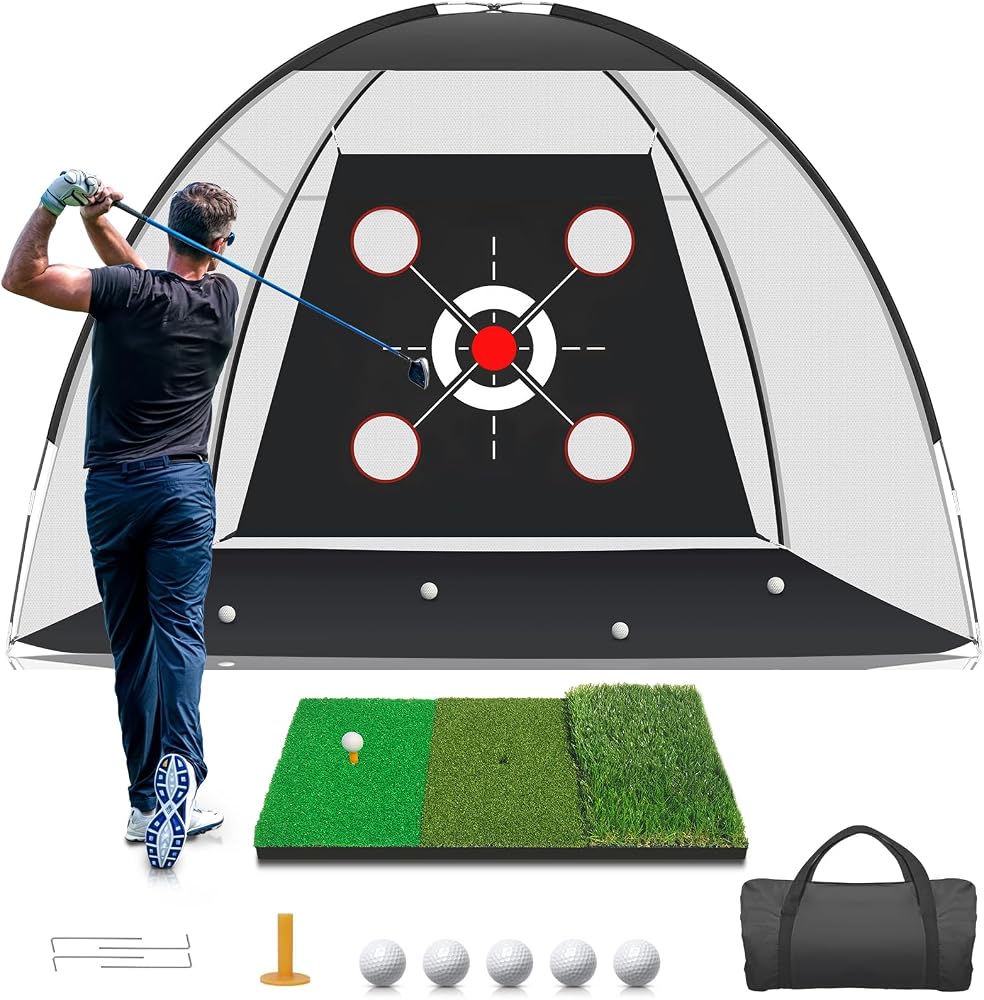
Golf Net with Practice Mat, 10x7FT Hitting Aid
Ten by seven hitting area with mat, target and balls in one box, up and swinging in minutes
Netting and mat are wear items, and the rating on the box is not the same as surviving real balls at real speed
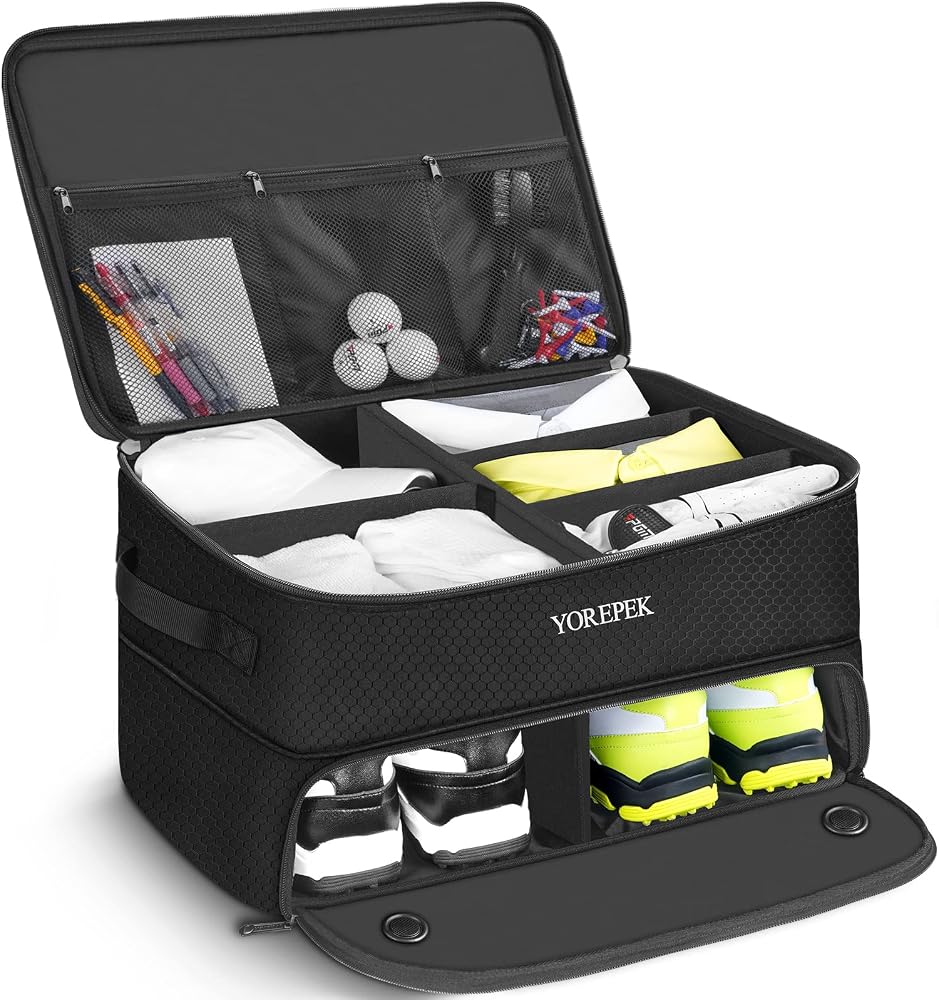
YOREPEK Golf Trunk Organizer
Two layers, room for two pairs of shoes, ventilated compartment, waterproof construction
Takes up trunk space whether you use it or not, and it will not fit alongside a full bag in a small car
Prices and availability were captured from Amazon Creators API and may change.
How I judge gear at this price
Four questions, every time. What does it do that the $40 option does not? Will it survive a season bouncing around in a bag or a trunk? What breaks first, and can I fix or replace that part cheaply? Would I still recommend it at month six rather than week one?
That last question is the one almost nobody answers. A rangefinder that locks a flag on day one is not interesting. A rangefinder that still locks a flag after a summer of cart rides, a couple of drops on a path, and a hundred trips in and out of a side pocket is interesting. Same logic for a net that has to eat real golf balls instead of foam, and for a polo that has to survive a Phoenix summer of sweat and sunscreen. My bar for any net or mat is real balls at real speed, not foam. If a product cannot clear that bar, it does not get a recommendation from me, no matter how good the listing looks.
The rangefinder: the one piece of tech that changes your score
The Acer Gadget Golf Rangefinder is the only item on this list that touches your scorecard directly. The specs that matter are 6X magnification, flag pole locking vibration, slope with an on/off switch, a rechargeable battery, and a magnetic stripe. Let me translate each one.
6X is the right magnification for golf. More is not better here. Past 7X, the shake in your hands gets magnified along with the flag, and you end up fighting the unit instead of reading the number. Flag pole locking vibration is the feature I care about most. When the unit buzzes to tell you it grabbed the stick rather than the tree behind it, you stop second-guessing and pull a club. Slope on/off is what makes a rangefinder legal for tournament play. Leave slope on for casual rounds so it shows the adjusted distance, flip it off for anything that counts, and you are covered either way. Rechargeable means no hunting for a specialty battery on the first tee, which is a small thing until it is a very big thing. The magnetic stripe lets it stick to the cart frame instead of riding loose in a cup holder.
The trade-offs are real. A laser rangefinder only helps if you know your stock yardages in the first place. If you do not know how far your 7 iron actually flies, a rangefinder just gives you a more precise way to be wrong. It also requires a charged battery, and a dead unit is dead weight. And if you play one course over and over, a yardage book and a couple of sprinkler heads do the same job for free. What a rangefinder buys you is speed and confidence on unfamiliar courses, and that is worth paying for.
Acer Gadget Golf Rangefinder with Slope On/Off: Visit on Amazon →
The practice net: the biggest risk and the biggest upside
A ten by seven foot net with a practice mat, a target, and balls in the box is the highest-upside and highest-risk purchase here. Upside: you can hit full swings into it in a backyard, and that is worth more than any gear upgrade you can buy. Risk: netting and mats are wear items, and the number printed on the box is a marketing figure, not a guarantee.
Size is the part I would focus on. Ten feet wide and seven tall is big enough to swing a driver without feeling like you are aiming at a postage stamp, and that matters, because a net you are scared of is a net you will not use. A separate target gives you something to aim at, which turns mindless swinging into actual practice. Balls in the box means you can hit the day it arrives instead of ordering more stuff first.
Now the part nobody wants to hear. Netting takes the abuse, and it is the first thing to go. When I look at a net, I want to know whether the panels are replaceable and whether I can hang an extra layer of padding behind the target without rebuilding the frame. Mats tear at the hitting strip, which is exactly where your club contacts, so treat a mat as a consumable rather than a permanent fixture. Budget for replacing it eventually, or lay a better strip on top. And check your surroundings. Ten feet of net does not stop a shank, and neither does any other net, so position it so a miss goes into a fence rather than a neighbor's window.
What a net cannot do is tell you where the ball went. Without a launch monitor, you get swing reps and contact feedback, not ball flight data. That is still a good deal, but go in knowing which one you bought.
Golf Net with Practice Mat, 10x7FT Hitting Aid: Visit on Amazon →
The polos: five shirts, one decision
Five performance polos in one order is a laundry-cycle problem solved. Three-button placket, moisture wicking, lightweight, tagless, quick dry, sun protection. For a summer round, that list is close to a complete spec. The tagless detail matters more than people admit, because a scratchy neck label is the kind of thing that ruins hole 14.
The math works if you play two or three times a week. Five shirts covers a full week of rounds plus a range session, and you stop running a midweek load of laundry just to have something clean for Saturday. Quick dry and moisture wicking are not marketing fluff in a place like Arizona, where a cotton shirt is a sponge by the second green.
The risk with any multi-pack is fit. Performance fabric often runs compression-style, and multi-packs rarely label that clearly. If you are taller than about 5'10" or broad through the shoulders, order a size up, and check the return policy before you commit to five. A polo that rides up when you bend over to read a putt is worse than no polo at all.
Second risk: longevity. Lightweight performance fabric at a multi-pack price tends to pill, fade, and lose collar structure faster than a heavier shirt. Sun protection also degrades with repeated washing, so treat these as seasonal shirts rather than a five-year wardrobe. At this price that is a fair trade. Just do not expect the collar to still stand up in year three.
5 Pack Men's Polo Shirts Short Sleeve Golf T Shirt: Visit on Amazon →
The trunk organizer: the least fun purchase and the most underrated
Two layers, room for two pairs of shoes, and a separate ventilated compartment for balls, tees, clothes, and gloves, with waterproof construction. This is the item people skip and then regret around month three, when their trunk smells like a wet golf glove and there is sand in the spare tire well.
Shoes are the reason to buy it. Golf shoes come off wet, grassy, and muddy, and a two-layer organizer keeps them off your trunk carpet and away from everything else. The ventilated compartment is the detail that separates storing shoes from fermenting shoes. Balls, tees, gloves, and a spare shirt all get a home, which means you stop rebuilding your bag the night before a round because you cannot find a glove.
Trade-offs. It occupies trunk space whether or not you use it, and if you drive a small car with a full bag already in the back, it may not fit alongside everything else. Shoes still need to come out and dry properly, because a ventilated compartment slows the smell, it does not eliminate it. And if you already carry a fully stocked bag with a shoe pocket, this is a duplicate purchase. For everyone else, it is the cheapest way to stop treating a car trunk like a locker room floor.
YOREPEK Golf Trunk Organizer: Visit on Amazon →
What I would buy first
Order of operations, assuming you cannot do all four at once.
- Rangefinder. It is the only item that changes decisions on the course. Knowing the number and picking the right club saves strokes immediately, and the slope switch means one purchase covers casual rounds and tournaments.
- Practice net. Reps are the cheapest improvement in golf. A net in the backyard turns twenty minutes of dead time into twenty minutes of swing work, and the included mat and target get you started in one box.
- Trunk organizer. It is the smallest purchase here and it protects everything else you own, including the shoes and gloves you already paid for.
- Polos. Last only because it is the least urgent. Buy them when your current shirts have visible sunscreen stains, which they will by September.
One rule I follow: buy two of anything cheap that breaks, like brushes, towels, and lanyards, but do not buy two of anything that solves a real problem. Get the one rangefinder, use it, and let the durability record build.
What breaks first, and what that costs you
Rangefinder: the battery is the failure point in most units, which is exactly why a rechargeable one is worth having. Watch the eye cup and the focus ring, because a focus ring that turns in your pocket means you re-focus every time you pull the unit out. Keep it in the case, not loose in the bag.
Net: netting first, mat second, frame last. Panels and hitting strips are replaceable, so a net with a solid frame and a torn panel is a fixable problem, not a dead product.
Polos: collar structure and pilling. There is nothing to repair, which is why the multi-pack price is the right way to buy them.
Trunk organizer: zippers and the ventilated panel. Keep sand out of the zippers and they will last, since sand is what kills zippers on anything that lives in a car.
The honest verdict
None of these four is a glamorous purchase. That is the point. A rangefinder, a net, a stack of shirts, and a trunk locker are the unglamorous stuff that makes rounds happen and practice happen. Put your money into the rangefinder first if you want a score change, the net first if you want a swing change, and the organizer and polos whenever you are tired of the mess and the laundry. All four together still land in the same range as a single new driver, and they will do more for your game.