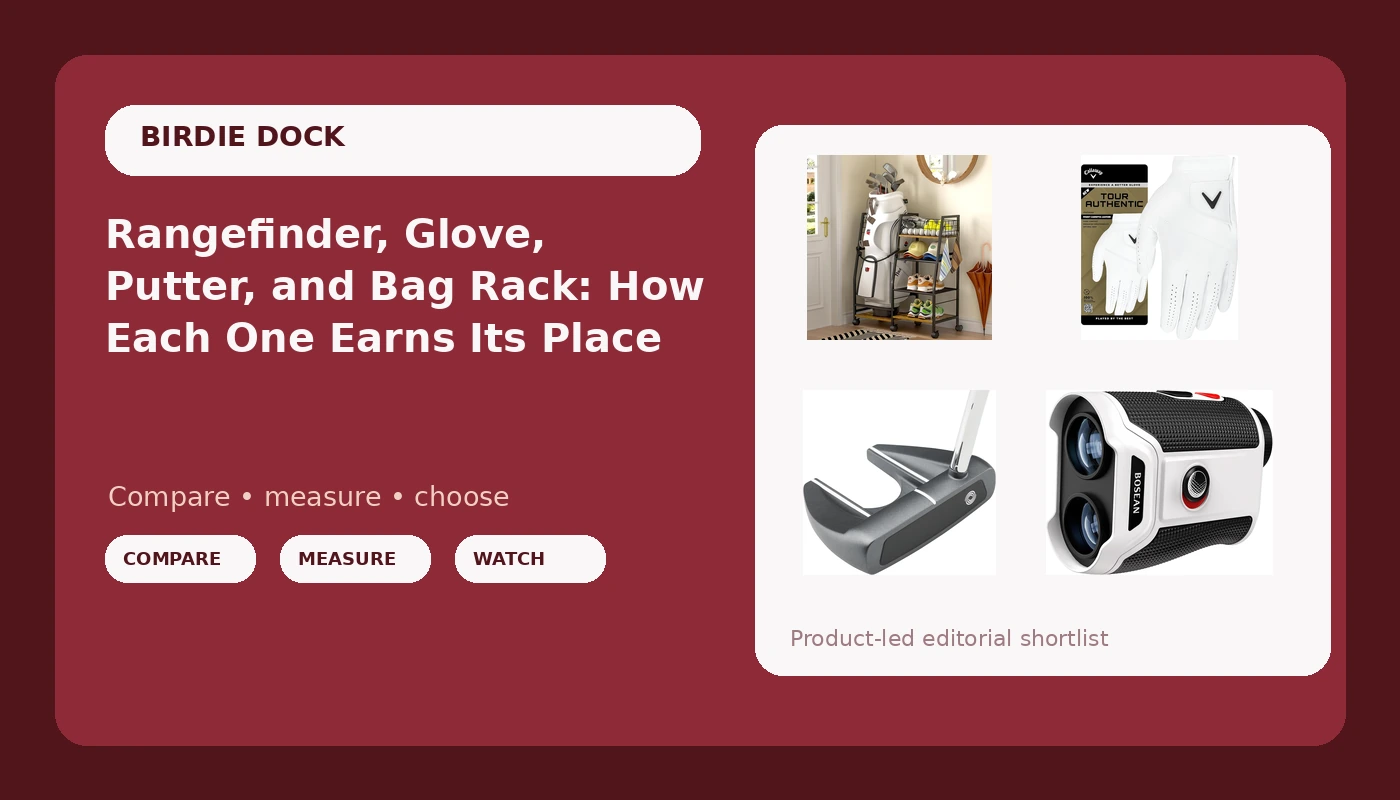
Most golfers don't need better clubs. They need the right handful of items and a system for keeping them. That is the whole premise behind buying golf gear essentials: a rangefinder that hands you a number, a glove that keeps the club from twisting in your hands, a putter that starts the ball on the line you picked, and a place to park the bag when the round is over. Four categories, four different buying questions, and almost no overlap in how you should think about them.
The problem is that all four get marketed identically. Every listing claims tour validation, every price tag implies a leap in performance, and none of that tells you whether the item will still be in your bag two seasons from now. The useful question is narrower: what does this do that the cheapest sensible option does not? Answer that for each item and most of the decision makes itself. What follows is a walk through four specific options, the role each one plays, and the trade-offs that actually matter.
Related: Rangefinder Accuracy: What Changes Your Yardage and What Doesn't →
Quick answer
These four products solve four unrelated problems, so there is no single winner. A rangefinder answers "how far is it" on courses with no reliable markers. A glove is a wear item you replace when the palm goes slick. A putter is the one club where feel and roll matter more than the marketing, so it deserves the most hands-on testing. A garage rack is storage, not performance, and it only makes sense if your bag currently lives on the concrete floor. Buy for the problem you actually have, roughly in that order of impact on your score.
4 useful options
| Model | Best fit | What stands out |
|---|---|---|
| 1200 Yds Golf Range Finder with Slope, 7X Magnification Golf Rangefinder with Magnetic, FlagPole Lock Vibration, Rechargeable Golf Distance Finder for Hunting, Golf Accessories for Men Women | Players who want a yardage number on every shot | 7X magnification, magnetic body, flagpole lock vibration, rechargeable |
| DAOUTIME Golf Bag Garage Storage Rack with Wheels, Organizer for Single Golf Bag and Equipment Accessories, Ideal for Home, Garage, Club, Shed, Basement - Sturdy Wood and Metal Construction (Black) | Getting one bag and its accessories off the floor | Wood and metal construction, wheels, sized for a single bag |
| Callaway Golf Tour Authentic Glove | A replacement glove from a major brand | Part of Callaway's Tour Authentic glove line |
| Odyssey Golf DFX 2025 Putter | A putter upgrade you plan to keep for years | Odyssey DFX line, 2025 model |
Yardage tool: 1200 Yds Golf Range Finder with Slope, 7X Magnification Golf Rangefinder with Magnetic, FlagPole Lock Vibration, Rechargeable Golf Distance Finder for Hunting, Golf Accessories for Men Women
The feature list matters more than the brand here, and slope is the one item on it that needs a caveat. Slope-adjusted yardages are useful in practice rounds and casual play, but competition play generally requires slope mode to be switched off, so check the local rule before you count on it in a tournament. The second thing to look at is battery strategy. A rechargeable unit means you are not hunting for CR2 cells mid-round, which is a small convenience that becomes a large annoyance twice a season. Magnification and pin lock are what you will notice on every shot: the flag should lock quickly and the vibration should tell you it did. Ignore the marketing tier and read the spec sheet against those three items.
Storage: DAOUTIME Golf Bag Garage Storage Rack with Wheels, Organizer for Single Golf Bag and Equipment Accessories, Ideal for Home, Garage, Club, Shed, Basement - Sturdy Wood and Metal Construction (Black)
Be honest about what this is. It will not lower a score, and it is not competing with a wall hook on performance. What it competes with is the pile: the bag leaning against a shelf, a shoe bag on the floor, three sleeves of balls rolling under the car. If your garage or shed currently looks like that, the rack solves an organizational problem, and the wheels matter more than they sound because a rack full of gear is not something you want to drag. Measure the space before ordering, and remember that this is sized for a single bag rather than a fleet.
Grip: Callaway Golf Tour Authentic Glove
Gloves are the fastest-wearing item in the bag, and that changes how you should buy them. A glove that fits correctly and gets rotated between rounds lasts noticeably longer than one glove worn into the ground, so the practical move is to own two and swap them. Sizing is where most people go wrong: a glove should be snug across the palm with no slack in the fingers, and if it bunches when you grip the club, it is a size too big. Because a glove is a consumable, the question is not whether it is the best glove ever made, it is whether the fit is right and whether you are willing to replace it when the palm thins out.
Rolling the ball: Odyssey Golf DFX 2025 Putter
Putters are the exception to almost every rule about buying gear, because the club never needs to hit a ball 250 yards. It needs to start a ball rolling on your intended line, and that depends on how the head sits behind the ball for you, how the grip feels in your hands, and whether the length lets your arms hang naturally. A putter from a known line is a reasonable starting point, but the deciding factor is a test session: roll ten balls from six feet and see whether the face returns square without you thinking about it. Cost of ownership is also worth checking here, because a regrip is inexpensive compared with replacing the club, so a putter you like is worth keeping for a decade.
Prices and availability may change. Product images, names, and retailer links must be matched by verified ASIN. Do not state a current price, rating, stock status, or measured result without current evidence.
How to compare rangefinders without paying for a logo
The rangefinder category is where the price-to-performance spread is widest in all of golf. Two units can read the same pin to within a yard and sit hundreds of dollars apart, and the difference is usually in housing materials, brand warranty, and how long the company has been making optics rather than in the number on the screen. So compare feature lists directly instead of comparing tiers. Does it have flag lock with vibration confirmation? What magnification? Does it run on a rechargeable battery or disposable cells? Does slope switch off for competition? Does it mount magnetically to a cart? Those five answers separate the useful units from the expensive ones.
Then think about failure points, because those are what you will actually live with. A rangefinder lives in a bag pocket, bounces around in a cart, and gets pulled out twenty times a round. The parts that fail first are the small ones: battery doors, lanyards, and focus rings that rotate too freely and need adjusting every time you pull the unit out. When you compare two options, ask which one you can still use comfortably in month six, not which one looks better in the product photo.
What wears out first, and in what order
Every piece of golf gear has a clock on it. Gloves wear out first, often within a couple of months of regular play, which is why buying two is standard practice. Grips go next, and clean grips matter because dirt in the grooves and slick rubber both cost you control. Batteries and lanyards follow, and those are the cheap parts that turn into annoyances: a proprietary battery you cannot find, or a string lanyard that frays and snaps. Storage gear, by contrast, mostly fails through overload or weather exposure rather than use.
A simple method for deciding what to buy, and in what order:
- Write down the specific problem the purchase solves. Not "I want a new putter," but "I three-putt from twenty feet because I cannot judge the distance."
- Set a spending ceiling before you browse, and treat it as a hard limit rather than a starting point.
- Compare the feature lists of three options at different prices and name what the expensive one does that the cheap one does not.
- Check what it costs to maintain, fix, or replace the small parts: grips, batteries, lanyards, glove replacements.
- Re-check the purchase at month three. If it is not still earning its place, that is information for the next decision.
Practical rules that survive a season
- Rotate two gloves and they will outlast a single glove worn every round.
- Switch slope mode off before any competition round and confirm the local rule allows rangefinders.
- Keep a magnet-mounted rangefinder on the cart frame rather than loose in a pocket, which cuts down on drops.
- Store the bag on a rack or hook rather than the floor, especially in a garage where tires and lawn equipment share the space.
- Clean grips and clubfaces after each round. It costs nothing and it is the cheapest improvement available to any player.
Which option should you choose?
Choose the 1200 Yds Golf Range Finder with Slope, 7X Magnification Golf Rangefinder with Magnetic, FlagPole Lock Vibration, Rechargeable Golf Distance Finder for Hunting, Golf Accessories for Men Women when you play courses without reliable markers and want slope plus pin lock in one unit. Choose the DAOUTIME Golf Bag Garage Storage Rack with Wheels, Organizer for Single Golf Bag and Equipment Accessories, Ideal for Home, Garage, Club, Shed, Basement - Sturdy Wood and Metal Construction (Black) when the bag is living on the floor and the accessories are scattered around it. Choose the Callaway Golf Tour Authentic Glove when your current glove has gone slick in the palm and you need a replacement that fits properly. Choose the Odyssey Golf DFX 2025 Putter when you are ready to test putters in person and keep one for years rather than buying on looks.
One caveat: nothing on this list should be bought on the strength of a listing alone. Fit, room dimensions, and personal feel are decisions only you can make, and a rangefinder's slope mode or a putter's length can be the difference between a useful purchase and a drawer item.
The bottom line
Golf gear essentials are not one category, and treating them as one is how people end up overpaying. The rangefinder is a technology purchase, so compare features and battery strategy rather than brands. The glove is a consumable, so buy for fit and buy two. The putter is a feel purchase, so test it before you commit. The storage rack is a housekeeping purchase, so measure your space and be honest about whether you need it. Get those four questions right and you will spend less while ending up with gear that is still doing its job at the end of the season.