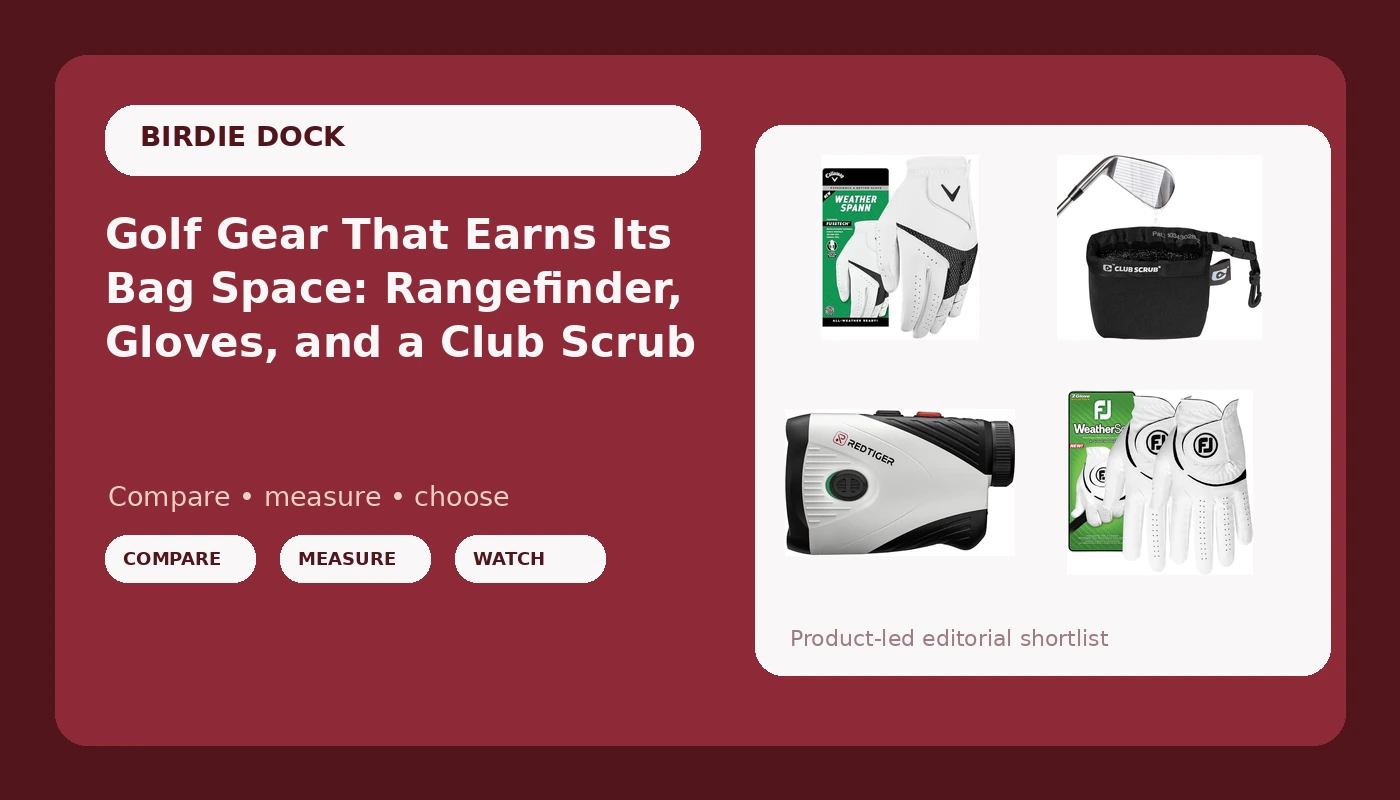
You can spend a lot of money on golf and still walk off 18 with the same score you shot last month. After six years behind a fitting counter and twelve years of playing, the upgrades that change a round are rarely the expensive ones. A rangefinder that gives you a real number, a glove that stays dry, and a cleaning bag that keeps your grooves free of dirt do more for a mid-90s player than a new driver ever will. This is a look at golf rangefinder and gloves essentials plus one groove tool, what each is actually for, and how to decide which one belongs in your bag this season.
Related: How to Dial In Your Wedge Distances Without a Launch Monitor →
Quick answer
The REDTIGER Golf Rangefinder with Slope On/Off, 7X Magnification 1200 Yards is the only piece of electronics in this group, and its switchable slope setting is what makes it useful in casual rounds and in events where slope readings are not allowed. The Club Scrub cleaning bag handles groove and ball maintenance between shots. The two glove options split by habit rather than by quality: a two-pack for players who rotate gloves during a round, and a single all-weather glove for players who want one pair of hands covered from the first tee.
Four useful options
| Model | Best fit | What stands out |
|---|---|---|
| REDTIGER Golf Rangefinder with Slope On/Off, 7X Magnification 1200 Yards | Yardages on courses you do not know | Switchable slope, 7X magnification, 1200 yard range |
| Club Scrub Golf Club and Golf Ball Cleaning Bag | Keeping grooves clean between shots | Waterproof clean face liner, detachable clip, machine washable |
| FootJoy Men's WeatherSof 2-Pack Golf Glove | Rotating gloves through a round | Two gloves in one purchase |
| Callaway Golf Weather Spann Glove | One all-weather glove | All-weather build from Callaway |
The yardage tool: REDTIGER Golf Rangefinder with Slope On/Off, 7X Magnification 1200 Yards
The slope switch is the detail I would point a friend toward first. Slope gives you a playing number that accounts for elevation change, which is genuinely useful on a course with big up and downhill approaches. Many tournament formats do not allow that reading, so a unit you have to leave in the car half the season is a unit you overpaid for. A model with an external switch, rather than one buried in a menu, solves that in about a second. The 7X magnification and the listed 1200 yard range are worth having even if most of your actual shots are inside 250 yards, because magnification is what lets you pick a flag out of a busy background instead of zapping the tree behind it.
The bag essential: Club Scrub Golf Club and Golf Ball Cleaning Bag, Waterproof Clean Face Technology Liner, Detachable Clip, Machine Washable, Cleans Club Grooves, Dry Exterior
This is the least glamorous item here and probably the one that shows up in the fewest bags. Clean grooves are free spin. Dirt and sand packed into a wedge reduce how much the face can grab the ball, and that shows up as a shot that lands short and rolls out instead of stopping. The two features that matter on a cleaning bag are the liner and the exterior. A waterproof liner means the wet side stays wet and the outside stays dry, so you can clip it to your bag without a towel underneath it. The detachable clip matters more than people expect, because the bag you carry in July is not always the bag you carry in January. Machine washable is the durability answer: when it gets gross, you clean it instead of replacing it.
The glove for rotating: FootJoy Men's WeatherSof 2-Pack Golf Glove
Gloves are the cheapest thing in golf that people replace the most often, and the reason is usually moisture. A glove that stays damp loses grip, then stretches, then gets retired early. Buying two at once is not about having a spare in case of a rip. It is about rotating on the back nine so the first glove can dry, which is the difference between a glove that lasts a season and a glove that lasts two months. WeatherSof is an all-weather line, so it is built for humid summer rounds as much as cooler mornings. Check the listing for current sizing and hand options before you order, because glove fit is one place where a half size off is noticeable on every swing.
The all-weather alternative: Callaway Golf Weather Spann Glove
If you only ever wear one glove until it wears out, this is the simpler path. One glove, one purchase, no pair sitting in the bag half the season. The trade-off is the same as buying anything one at a time: when it goes, you are ordering a replacement mid-season, and if you play in heat and humidity, that day comes sooner than you think. Check the listing for the current material and sizing details, since glove construction and fit vary across the line and across the years. If you play more than twice a month, the two-pack math usually wins on cost per round.
Prices and availability may change. Product images, names, and retailer links are matched to verified listings. No current price, rating, stock status, or measured result is stated here without current evidence.
How to read a rangefinder spec sheet
Three numbers do most of the work, and two of them get oversold. Magnification is the one people ignore and should not. At 6X or 7X you can separate a flagstick from a tree line or a fence post behind the green, which is the difference between a number you trust and a number you re-shoot twice. Listed maximum range is the second number, and it is almost always bigger than anything you will use. A 1200 yard rating is about the hardware's ceiling on a reflective target, not a promise that you will lock a flag at 1200 yards. Read it as headroom, not as a feature you will notice on a 400 yard par 4.
The third spec is the one that decides whether the unit is legal for your weekend. Slope measures elevation change and gives you an adjusted distance. That is useful information on an uphill approach, and it is not permitted in formats that require a device without slope functionality. The cleanest solution is a physical switch on the outside of the housing. Menu-based toggles exist, but you have to remember them, and a device you have to remember to configure is a device that gets you a penalty one Saturday morning.
Battery type is the quiet spec nobody mentions until it dies on the 12th hole. Rechargeable units with a standard cable beat anything that needs a specialty cell you have to buy at a pro shop for triple the price. When you compare models, put the charging method next to the price. It is part of the cost of ownership, not an afterthought.
Why gloves and clean grooves are the cheapest strokes you can buy
Your grip and your club face are the only two places your body touches the ball. Everything else in the bag is a delivery system for those two contact points. That is why the small items outperform their price. A dry glove keeps the club from twisting in your hands at the top of the swing. Clean grooves give the face a place to channel water and debris away from the ball at impact, which is how a wedge produces the check that holds a green instead of releasing past the pin.
Both of these degrade gradually, which is exactly why players ignore them. You do not notice a glove getting slick over three weeks, and you do not notice grooves filling in over a season of range sessions on sandy mats. Then one day your wedge rolls out and you blame the club. Maintenance items are the cheapest strokes in golf because they protect performance you already paid for. A cleaning bag and a second glove cost less than a single dozen premium balls, and they make every club in the bag behave closer to how it was designed to behave.
There is a durability argument too. A glove that never dries out between shots breaks down faster than one that alternates. Grooves packed with dirt require harder scrubbing later, which wears the face. Small habits compound, and the equipment that supports those habits is the least expensive equipment you will buy all year.
Here is the order I would work through before adding anything to the bag:
- Count how many rounds you played in the last three months. That number decides whether you need a two-pack or a single glove.
- Check whether your regular course has yardage markers you actually trust, or whether you are pacing off sprinkler heads every hole.
- Confirm what your league or club event allows regarding slope readings before buying a rangefinder with that feature.
- Look at your wedges after a round. If the grooves are caked with dirt, the cleaning tool comes before the next club purchase.
- Add up the cost of ownership, including batteries or charging cables and glove replacements, rather than looking at the sticker alone.
Practical guidance
- Buy the two-pack if you play more than twice a month. Rotation beats replacement every time.
- Choose the rangefinder with the external slope switch if you play any format that restricts slope, so you are not buying twice.
- Clip the cleaning bag where you can reach it without unzipping anything, or you will stop using it by the third hole.
- Wash the cleaning bag when the liner starts holding grit. A dirty cleaner is just moving sand around.
- Replace a glove when it feels slick, not when it tears. Slick costs you shots long before a hole appears.
- Check sizing charts for both glove options before ordering, since fit varies by line and hand shape.
Which option should you choose?
Choose the REDTIGER Golf Rangefinder with Slope On/Off, 7X Magnification 1200 Yards when you play unfamiliar courses and want a number instead of a guess, especially if you need slope you can switch off for events. Choose the Club Scrub Golf Club and Golf Ball Cleaning Bag, Waterproof Clean Face Technology Liner, Detachable Clip, Machine Washable, Cleans Club Grooves, Dry Exterior when your wedges stop holding greens and you suspect the face, not the swing. Choose the FootJoy Men's WeatherSof 2-Pack Golf Glove when you play often enough that one glove cannot dry between rounds, and choose the Callaway Golf Weather Spann Glove when you want a single all-weather glove and would rather replace it when it wears out.
One caveat on all four: the details that matter most at purchase time, including current pricing, available sizes, colorways, and material specifics, live on the listing and change. Read the listing for the exact variant you are ordering rather than assuming the model name covers one configuration. None of these four replaces a lesson or a fitting, and none of them will fix a swing flaw. They remove small, avoidable problems so the rest of your gear can do its job.
The bottom line
The bag that scores well is usually not the bag with the most expensive clubs in it. It is the bag where the grooves are clean, the glove is dry, and the player knows the number before pulling a club. Those three habits cost very little to build and they hold up over a full season, which is more than most gear purchases can claim. Start with the item that fixes the problem you actually have on the course, check the listing for current details, and give it six months before you decide whether it earned its spot.