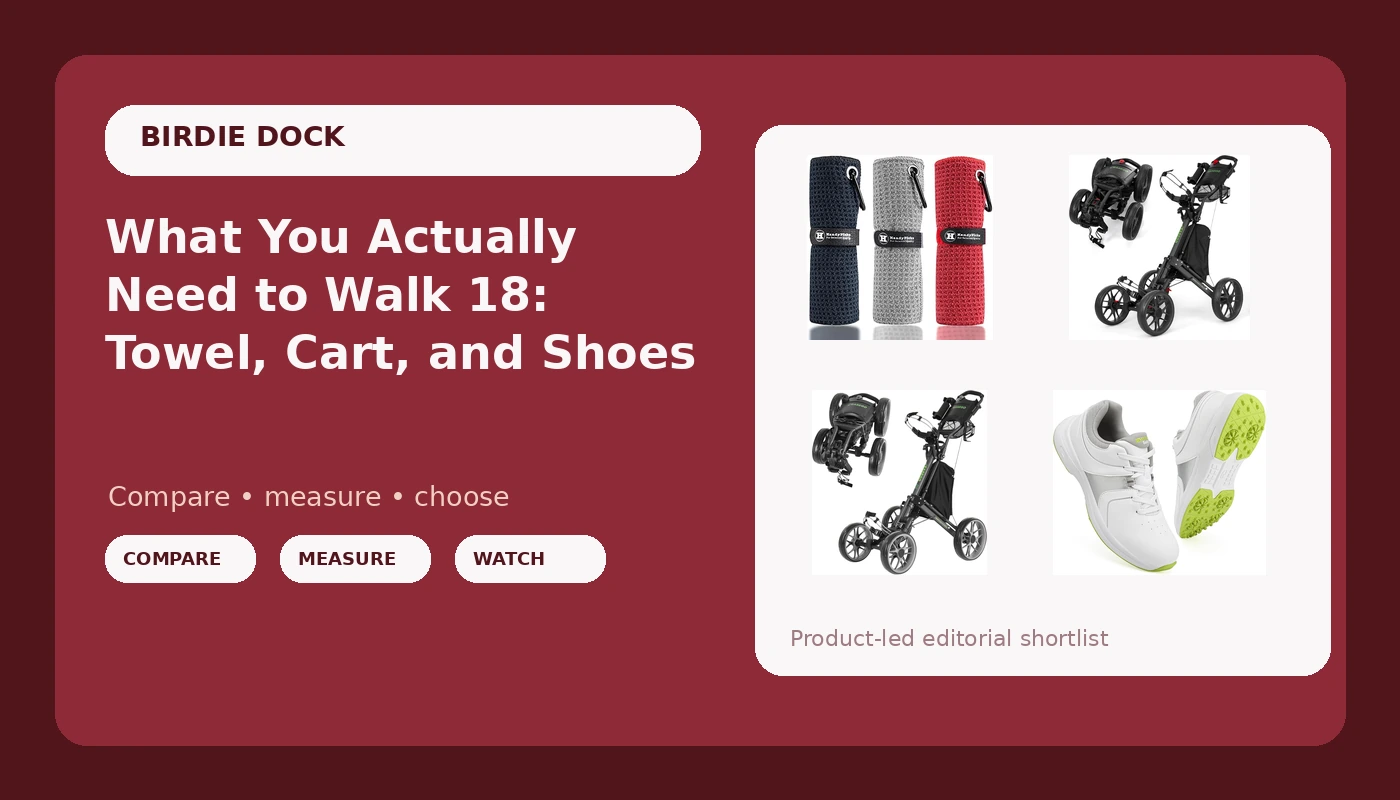
Walking 18 holes instead of riding is the cheapest upgrade in golf, and it is also the one most players get wrong on the equipment side. Not because walking is complicated, but because golf walking gear gets sold in three separate categories that do three separate jobs: something to clean your clubs with, something to carry the bag, and something to keep your feet dry and planted. Buy them out of order and you end up with a cart before you own a towel that costs less than a sleeve of balls.
This is an explainer, not a ranking. Below are four specific products from the current listings, what each one is actually for, and how to work out which piece your game needs next.
Related: Push Cart vs Carry Bag: What Walking 18 Actually Costs You →
Quick answer
Golf walking gear is not one purchase. A microfiber towel handles club face and groove cleaning, a four-wheel push cart takes the bag off your shoulders, and waterproof spiked golf shoes handle traction and moisture. If you already carry your bag comfortably and your feet stay dry, the towel is the cheapest item that can change how your clubs perform. If your back or shoulders are what give out on the back nine, the cart is the piece that changes your round. Match the purchase to the problem you actually have instead of buying all three at once.
Four useful options
| Model | Best fit | What stands out |
|---|---|---|
| Handy Picks Microfiber Golf Towel (16" X 16") | Club and groove cleaning during a round | 16 x 16 inch waffle-weave microfiber with a carabiner clip and hook-and-loop fastener |
| EASEGO Golf Push Cart 4 Wheel | Taking the bag off your shoulders | Four-wheel walking cart built as a push cart and caddy cart |
| EASEGO Golf Push Cart 4 Wheel (second listing) | The same cart when one listing is unavailable | Same EASEGO four-wheel walking cart sold under a separate listing |
| Golf Shoes Mens Waterproof Professional Spiked Golf Cleats | Traction and dry feet in wet conditions | Waterproof men's golf shoe with a spiked cleat outsole |
The cleaning piece: Handy Picks Microfiber Golf Towel (16" X 16")
A towel is the lowest-risk purchase in this group, which is exactly why it should come first. Clean grooves are free spin: a wedge face packed with dirt, grass, and moisture cannot grip the ball the way a clean face does, and the miss shows up as a shot that flies farther than expected and rolls out instead of stopping. You do not need a brush, a reservoir, or a gadget to fix that on the course. You need something dry and textured hanging where your hand already goes between shots. The trade-off is that this is a towel, not a cleaning system. There is no water reservoir, no bristle head, and no groove tool in the listing, so heavy mud on a wet morning is still going to need a proper brush back at the car. The clip is the feature that matters most here, because a towel that lives on the ground is a towel you stop using.
The bag carrier: EASEGO Golf Push Cart 4 Wheel
A cart changes the physics of your round more than any other item on this page. Carrying a bag loads one shoulder and one side of your spine for four hours, and the fatigue shows up late, which is when your swing tends to get quicker and your tempo goes. Moving that load onto a frame with wheels keeps your legs working and your shoulders fresh. The four-wheel layout is the detail worth understanding: a four-wheel cart spreads the load across a wider footprint and stays upright on its own, so you push it rather than balance it, while a two-wheel pull cart trails behind you and tips if you let go on a slope. The trade-off is bulk. A cart takes up trunk space, needs to be folded and unfolded every round, and does nothing for you on a course that requires riding. If you already walk with a lightweight carry bag and finish 18 without noticing your shoulders, this is the piece you can skip.
The second listing: EASEGO Golf Push Cart 4 Wheel
Duplicate listings are normal on Amazon, and they are worth understanding rather than ignoring. The same physical product can appear under more than one listing when a seller relists it, changes the parent variation, or runs a separate offer. For you, that means two things. First, if you decide the EASEGO four-wheel cart is the one you want, check both listings before you commit, because availability is not guaranteed to be the same on each. Second, read the listing you are actually buying from. Confirm the product name, the wheel count, and the photos match what you expect, since a second listing is a separate page that can carry different details. Treat this entry as a sourcing note, not a different product. It is the same four-wheel EASEGO walking cart, and it is not a second cart you need to own.
The traction piece: Golf Shoes Mens Waterproof Professional Spiked Golf Cleats
Shoes are the piece most players replace last and should probably replace sooner. Walking 18 means roughly four hours on grass, slopes, and cart paths, and wet feet are not just uncomfortable, they change how hard you can push off the ground through the swing. A spiked outsole bites into soft turf in a way a spikeless sole does not, which matters most in morning dew, after rain, and on the soft fairways that show up in spring and fall. Waterproofing matters for the same reason: once a shoe soaks through, it stays heavy for the rest of the round. The trade-off is that spikes are a maintenance item. They wear down, they need replacing, and some courses restrict metal spikes, so check the policy where you play before you buy. Spikeless shoes are easier to wear off the course and lighter on hard, dry turf, but they give up grip in exactly the conditions where a walker notices it most.
Prices and availability may change. Product images, names, and retailer links must be matched by verified ASIN. Do not state a current price, rating, stock status, or measured result without current evidence.
What each piece of walking gear actually does
It helps to separate the three jobs, because they fail in different ways.
The towel is a contact problem. Your club face meets the ball once, and whatever is on the face at that moment is part of the shot. Dirt and moisture in the grooves reduce friction, and reduced friction means less spin and a flatter, longer ball flight than you planned for. This shows up most on wedges and short irons, where you are trying to stop the ball rather than chase it. A dry waffle-weave microfiber towel removes the grit and the moisture in one wipe, and because it clips to the bag, it is there before you put the club back.
The cart is a load problem. Carrying a bag puts weight on one shoulder and one side of your body for the length of a round, and the accumulated fatigue tends to show up in the last four or five holes. A push cart moves that load onto a frame, so your legs do the work and your upper body stays loose. Four wheels versus two is a stability question, not a quality question: more contact points mean the cart stands on its own and rolls with less effort to keep upright.
The shoes are a ground problem. Traction is what lets you rotate through the ball without your feet sliding, and waterproofing is what keeps the shoe from getting heavy halfway through a wet round. Spiked outsoles are built for soft conditions. Spikeless outsoles are built for firm, dry conditions and for walking off the course afterward. Neither is wrong, they just answer different questions.
How to decide which piece to buy first
Work backward from the thing that is actually costing you shots, not from the thing that looks best in a product photo.
- Name the failure. If you fade on the last five holes, that is a load problem. If you slip on tee shots in the morning, that is a traction problem. If your wedges run out instead of checking, that is a clean-groove problem.
- Audit what you already own. Most players have a towel somewhere in the bag and a pair of shoes that are two seasons past their useful life. Buy the missing piece, not a duplicate.
- Match the gear to your typical conditions. Dewy morning rounds and soft fairways favor waterproof spiked shoes. Firm, dry, walkable courses make spikeless viable and a cart more valuable.
- Price the cost of ownership, not just the purchase. A towel is cheap to replace. A cart takes trunk space and needs to be stored dry. Spiked shoes need replacement spikes over time.
- Buy the smallest item that fixes the biggest problem, then re-evaluate after a month. The cheapest fix that works beats the expensive fix you did not need.
Living with walking gear over a full season
- Clip the towel where your hand already goes after a shot, usually the same side as your bag's putter well. A towel you have to unzip for is a towel you stop using.
- Wash microfiber towels on their own and skip fabric softener, which coats the fibers and reduces how much moisture they pick up.
- Store the cart dry and folded, and check the wheels and frame before your first round of the season rather than on the first tee.
- Let waterproof shoes air-dry at room temperature. Heat sources crack the upper and break down the waterproof layer faster than any amount of walking.
- Inspect the spikes every few months. Worn spikes are the reason a shoe that gripped well in spring feels slippery by August.
Which option should you choose?
Choose the Handy Picks Microfiber Golf Towel (16" X 16") when your clubs come back dirty, your wedges are not stopping, and you want the least expensive change that affects every shot you hit. Choose the EASEGO Golf Push Cart 4 Wheel when your shoulders or back are what limits you on the back nine and you want the load off your body for the whole round, with the second EASEGO listing as the alternate source for the same cart. Choose the Golf Shoes Mens Waterproof Professional Spiked Golf Cleats when you walk in dew or wet conditions, your feet get soaked, or you slip on shots and want a spiked outsole under you.
There is one caveat that applies to all four. Everything here is drawn from the product listings themselves, not from measurements taken on a course, so verify the current details on the listing page before you buy. Sizing, sole type, wheel configuration, and material specs can change between production runs, and a second listing for the same cart is a separate page that deserves its own read.
The bottom line
Walking gear solves three separate problems, and buying them in the order of the problem rather than the order of the price tag is what keeps the spending sensible. The towel is the cheapest item on this page and the one that touches every shot. The four-wheel EASEGO cart is the piece that changes how your body feels at the 15th hole. The waterproof spiked shoes are the piece that keeps you planted and dry when the ground is not on your side. If you already walk comfortably, carry a clean towel, and stay dry, you do not need any of this yet, and that is a perfectly good answer.