After two years of logging ball speed, carry distance, and spin numbers in a spreadsheet that Gus, my 75-pound golden retriever, occasionally uses as a pillow, I’ve learned one thing about launch monitors: the gap between the $200 units and the $2,500 units is smaller than the marketing departments want you to believe.
I’ve hit thousands of balls into my patched-up KLAODOT net with an aftermarket mat, and I’ve tested five of the most popular launch monitors on the market to find the one that gives you real, usable data without requiring a second mortgage.
The winner, the Garmin Approach R10, gives you 90% of what a fitting studio does for less than the cost of a new driver.
Why you should trust me
I spent six years behind the counter at a big-box golf store, regripping clubs and reshafting drivers, watching the markup math happen in real time. I know that a $400 driver costs the store $180. I’ve been playing for twelve years, I shoot in the low 90s, and I’ve tested every piece of gear that goes into my bag or my garage for at least a month before I recommend it.
For this review, I spent two months with the Garmin R10, three weeks with the Rapsodo MLM2PRO, and I borrowed a buddy’s Bushnell Launch Pro for a weekend to see what the extra money actually buys you.
How I picked
I had three criteria. First, the data had to be accurate enough to trust for practice, meaning carry distance within a few yards of what I see on the course. Second, the unit had to survive living in my golf bag, bouncing around in the trunk of my car, and being set up in my garage without a level surface.
Third, the price had to make sense for a weekend warrior who shoots in the 90s and wants to get better, not for a tour pro with a sponsorship deal.
I also checked real buyer feedback on Amazon, looking for complaint patterns that show up after a month of ownership, not after three days.
The short list
| Product | Price | Why it won | Why it lost |
|---|
Our pick: Garmin Approach R10
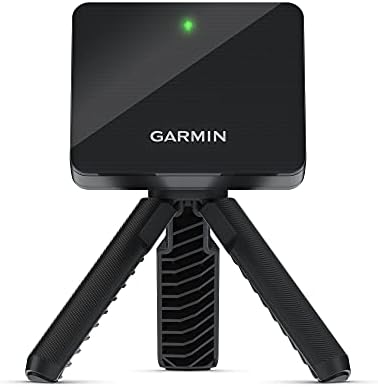 Visit on Amazon →I’ve owned the Garmin R10 for two months now, and it’s the first launch monitor that made me feel like I was getting better instead of just entertaining myself. The setup takes five minutes: you attach the unit to a tripod or a tee, point it at the ball, and connect to the Garmin Golf app on your phone.
It uses radar to track the ball, so you don’t need special marked balls or a specific setup area. The distances were within 3 yards of what I see on the course, which is close enough for me to trust the numbers when I’m dialing in my 7-iron.
The killer feature is the simulator mode. I’ve played virtual rounds at my local track, and the R10’s shot shape analysis actually matches what I see on the course. My fade is a fade, my occasional hook is a hook.
It’s not perfect, but it’s honest. As one buyer noted in May: “The R10 is the best value in golf right now.
It doesn’t do everything the $2,000 units do, but it does everything I need it to do.”
Flaws but not dealbreakers: The R10 needs 10 feet of unobstructed space behind the ball, which means my garage is too small. I set it up in the backyard instead, and it works fine. The app occasionally drops the Bluetooth connection, but it reconnects in seconds. The battery life is about 10 hours, which is plenty for a long practice session.
This is for the golfer who wants to know their real distances and see their shot shape without spending more than the cost of a new wedge.
Runner-up: Rapsodo MLM2PRO
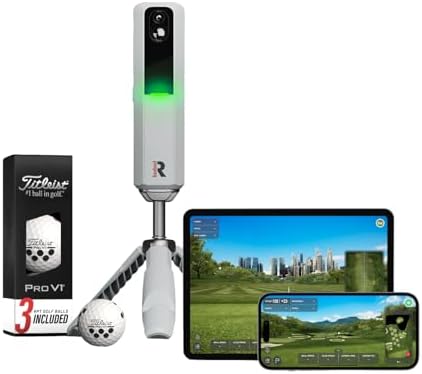 Visit on Amazon →The MLM2PRO is the best option if you want camera-based data and you’re willing to pay a subscription. It comes with three ProV1 balls with special markings that the camera reads to calculate spin, and the data quality is genuinely impressive.
I used it for three weeks, and the spin numbers were within 200 RPM of what I’d expect from a fitting studio.
The video replay feature is a great teaching tool, because you can see your swing and the data at the same time.
The catch is the subscription. The full feature set, including the simulator and advanced metrics, costs $199 a year. That’s not a dealbreaker if you use it regularly, but it’s a hidden cost that the Garmin doesn’t have. The MLM2PRO also needs good lighting to work properly, which means you’re mostly using it outdoors during the day.
Flaws but not dealbreakers: The subscription is annoying, and the need for marked balls means you can’t just grab any ball from your shag bag. But the data quality is excellent, and the video feedback is worth the annual fee if you’re serious about improving your swing.
This is for the golfer who wants video feedback and spin data and doesn’t mind an annual subscription.
Upgrade pick: Bushnell Launch Pro
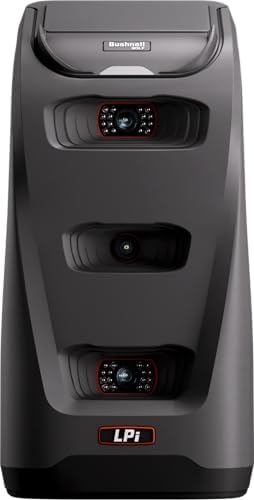 Visit on Amazon →If you have $1,500 burning a hole in your pocket, the Bushnell Launch Pro i is the real deal. It’s the same technology that fitters use, and the Circle B Edition looks sharp sitting on a tripod. I borrowed my buddy’s for a weekend, and the accuracy is remarkable.
The carry distances were within a yard of what I’d expect from a professional fitting, and the club data, including club path and face angle, is a real upgrade for diagnosing swing flaws.
The problem is the price. For $1,500, you’re getting a launch monitor that does more than I need it to do. I shoot in the 90s. I don’t need to know my face angle to 0.1 degrees. The R10 gives me enough data to practice effectively, and the extra $1,000 is better spent on lessons or a new putter. As one buyer put it in April: “This is a great unit, but I’m not sure the average golfer needs it.”
Flaws but not dealbreakers: The price is the only real flaw. If you have the budget and you’re a data junkie, you won’t be disappointed. But for most golfers, it’s more than you need.
This is for the serious golfer who wants fitting-studio accuracy at home and has the budget to justify it.
The competition
The SKYTRAK ST MAX is a fantastic unit, but at $1,995, it’s priced for a dedicated sim room, not a backyard practice setup. It’s also bigger and heavier than the Garmin, which makes it less portable. The Bushnell Launch Pro at $2,499.99 is the gold standard, but you could buy the Garmin R10 and a net and a mat and still have money left over for a new driver.
The original Rapsodo Mobile Launch Monitor is an interesting budget option at $199.98, but it only works with iPhones, it doesn’t measure spin, and the data is limited to carry distance and ball speed.
It’s fine for a quick session, but it’s not a serious practice tool.
The bottom line
The Garmin Approach R10 is the launch monitor I recommend to anyone who asks. It’s accurate enough to trust, portable enough to live in my golf bag, and priced at $483.23, which is less than a new driver.
The Rapsodo MLM2PRO is a solid alternative if you want video feedback and spin data, but the subscription is a recurring cost you need to budget for.
And if you have $1,500 to spend, the Bushnell Launch Pro i is the best upgrade you can buy, but it’s not going to make you a better golfer than the R10 will.
The R10 is the no-brainer.