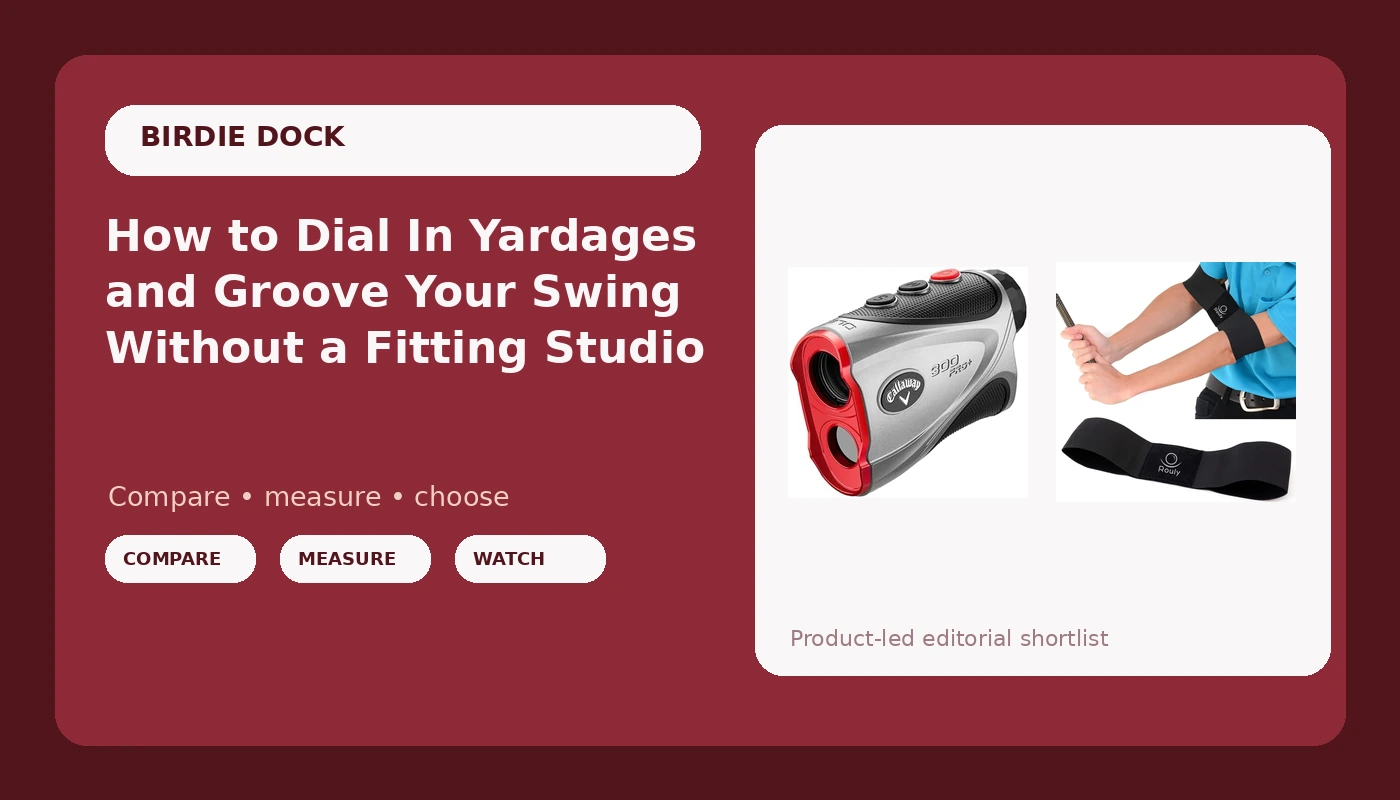
Most players think they have a swing problem when they actually have a number problem. I play out of Scottsdale, and the track I play most weekends does not have a single yardage marker on it, which is exactly why I carry a rangefinder instead of pacing everything off from the 150 post. But a number only helps if the move that produces it repeats. That is why a golf swing trainer and rangefinder belong in the same practice bag. One tells you what the shot is. The other makes the shot repeatable.
This is not a guide about which launch monitor to finance. It is a how-to for the player who wants two cheap tools and a practice routine that actually changes a score. The whole setup here costs less than a single new wedge, and you can run the first session this weekend on a range mat.
Here is the order I would do it in, and the two tools I would start with.
Why you should trust me
I spent six years behind the counter of a big box golf store as a club fitter and repair tech. I have regripped a thousand clubs, reshafted drivers, and watched the markup math happen in real time. That inside view killed whatever brand loyalty I had.
I have been playing golf for twelve years. I shoot in the low 90s and I am fine with that. When I recommend something, the question is never whether it looks good in the bag. It is whether it survives a season, what breaks first, and whether I can fix that part cheaply. That is the test.
How I picked and how I judge gear
Two tools, two different jobs, and I judged them on different things.
For anything that gives me a number, I look for three things. First, pin lock: the vibration when the laser grabs the flag instead of the tree behind it. If a unit hesitates on the flag, it is useless, no matter what it costs. Second, an external slope switch, because slope has to be off for a tournament round and I do not want to dig through a menu on the first tee. Third, the battery. Proprietary batteries are a tax, and I would rather charge over USB or swap a common cell.
For anything that trains a move, the bar is lower and the stakes are higher. A training aid has to be small enough to live in the bag, simple enough that you use it without thinking, and cheap enough that replacing it is not a decision. If it costs more than a dozen balls, it needs to earn that back in the first month.
I do not care about "tour proven" printed on anything. No tour player has touched the gear in this article. That is fine. Neither have most of the people reading it.
The two things you need before you start
Everything below assumes you have a range, a few real balls, and 30 minutes. No simulator, no fitting bay, no paid session.
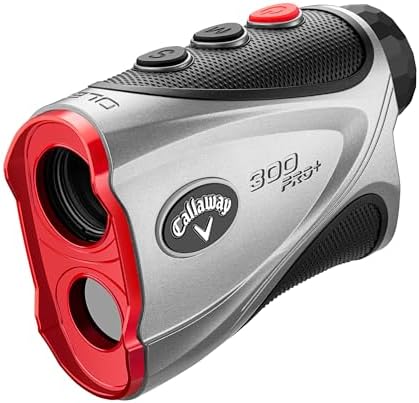
For the number: Callaway 300 Pro Golf Laser Rangefinder (with External Slope Switch)
 Visit on Amazon →
The reason this one is on the list is in the name: the slope switch sits on the outside of the housing, not buried in a menu. That matters more than most players realize. Slope gives you the adjusted distance to a flag that sits above or below you, which is genuinely useful on a course with elevation. It is also not legal for a round that counts. An external switch means you flip it off before you tee off, glance down to confirm, and stop worrying about it.
The rest is what I want from any laser: a housing that survives bouncing around a cart, a diopter you set once and forget, and a pin lock that grabs the flag rather than the bunker lip behind it. Callaway has been in this category long enough that the basics are handled. What I would check on day one is the eye focus ring, because a focus ring that turns in your pocket means you re-focus every single time you pull the unit out, and that gets old by the third hole.
What to look for: a firm detent on the focus ring, a slope switch that clicks instead of sliding loosely, and a case you will actually use. A rangefinder that lives loose in the bag is a rangefinder with a scratched lens.
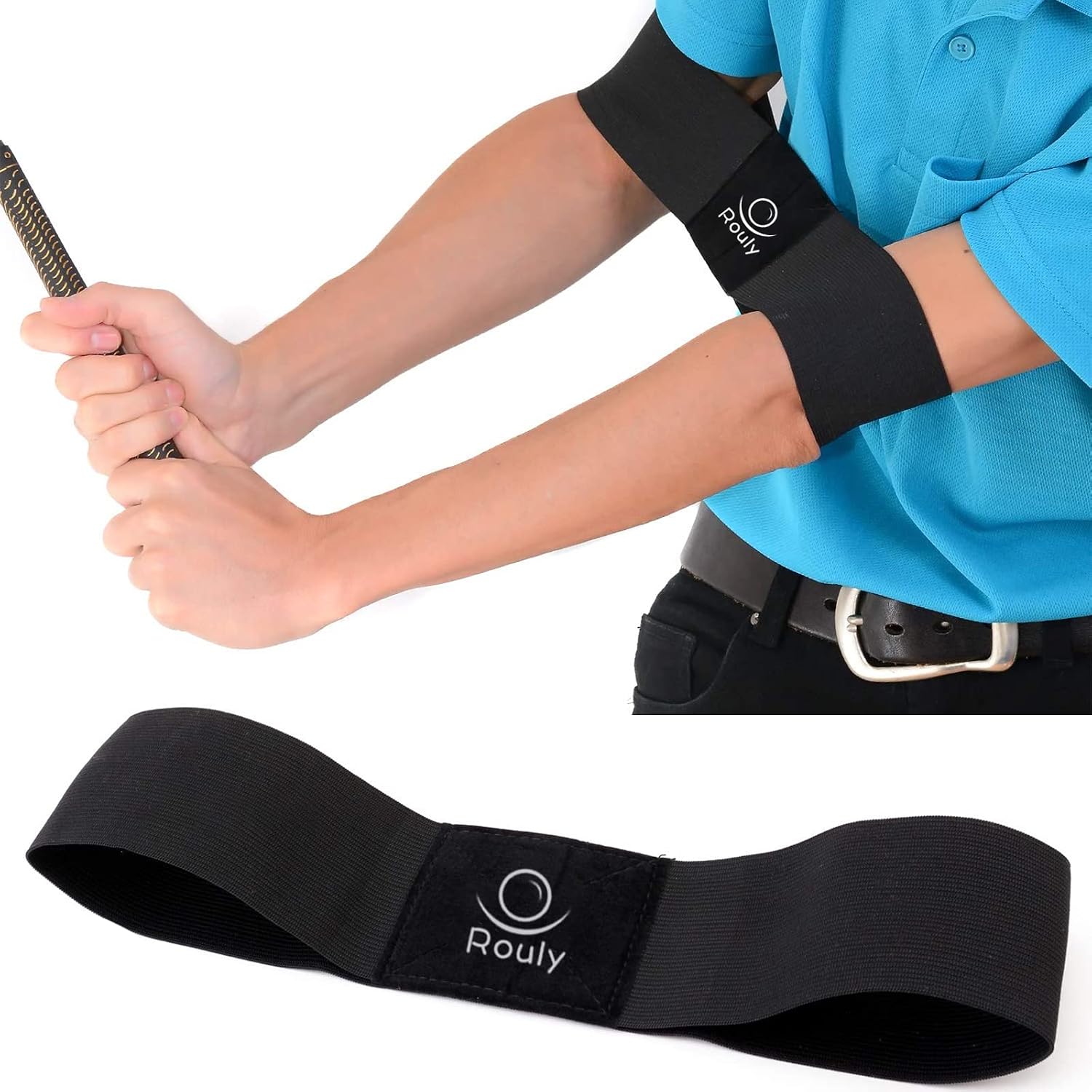
For the move: Golf Swing Trainer Aid,Swing Correcting Arm Band, Swing Easy Black
 Visit on Amazon →
An arm band does one job: it keeps your lead arm and your trail arm working as a unit instead of letting the trail elbow fly and the hands separate. When your arms stay connected, the club stays in front of your chest, the low point of the swing gets more consistent, and the thin and fat misses quiet down. That is the whole pitch, and it is a real one.
What I like about this style of band is the price of entry. You can keep it in the bag, use it for five minutes before a round, and never think about it again. It is also the kind of item that gets lost, borrowed, or left on a range mat, which is a strong argument for owning a cheap one rather than a premium one.
What to look for: a strap that holds its position without cutting into your arm, and enough adjustability to wear it over a polo or a light layer. If the band slides up your bicep mid-swing, you will stop using it.
The actual workflow
Here is the routine. Do it twice a week for a month before you decide anything about your swing.
Step one: get a real number for three clubs. Take the rangefinder to the range, pick a target, and shoot it. Then hit ten balls with your pitching wedge and write down where they land relative to that number. Do the same with your 7 iron and your 5 iron. A lot of players are surprised to find their 7 iron flies 145, not 155. That gap is the difference between the middle of the green and the front bunker.
Step two: shoot the trouble, not just the flag. The flag number is the least useful number on the course. What changes your score is knowing the carry to the front bunker, the number to the water, and the number to the corner of the dogleg. Practice this on the range: shoot a flag, then shoot the mower stripe behind it, then shoot the net on the left. The habit of ranging three targets per shot is what separates a player who uses a rangefinder from a player who owns one.
Step three: strap the band on for the first ten swings. Warm up with it. Ten slow swings at half speed, feeling the arms stay together. Do not chase distance with it on. The band is a feel trainer, not a speed trainer.
Step four: take it off and hit ten more. This is the part people skip. The band teaches a position. Your job is to reproduce that position without it. Hit ten balls at full speed and watch the ball flight. If you start hitting pushes and slices, your arms are separating again and the trail hand is taking over. That is useful information, not failure.
Step five: use it as a checkpoint, not a crutch. After the first month, the band comes out when the swing goes sideways, not every session. Ten swings at the start of practice, then off. If you find yourself needing it for every shot, the problem is not connection, it is something else, and a cheap band was never going to fix a grip that is too weak.
Step six: take the numbers to the course. Write your three carry distances on a piece of tape on the cart or in a yardage book. Then use the rangefinder for the number you actually need. Pin in the middle, no wind, no trouble: shoot the flag. Pin tucked behind a bunker: shoot the bunker lip first, then the flag. This is course management, and it is free.
Step seven: clean your grooves before you trust any number. Clean grooves are free spin. A dirty wedge face turns a 100 yard shot into a 100 yard shot that rolls out eight feet. If you are going to spend 30 minutes on the range working on distance control, spend 30 seconds cleaning the face first.
What this setup will not do
It will not fix a slice caused by an open clubface. It will not add swing speed, and it will not replace a lesson. If your path is eight degrees out to in, a band that keeps your arms together just makes the same bad swing more consistent.
It also will not give you the data a launch monitor gives you. You will know carry distance, not spin rate or launch angle. For most players shooting in the 90s, carry distance is the number that changes the score. Spin rate is a fitting conversation, and fitting conversations are a different budget entirely.
One more caveat: do not buy a training aid and skip the practice. I have watched a lot of gear get sold to people who never hit a ball with it. The band is the cheap half of the equation. The practice is the expensive part.
What this all costs
The rangefinder is the real purchase here, and it is a one time cost that lasts years if you keep it in a case. The band is the price of a sandwich, and you should probably buy two so one can live in the bag and one can live in the car.
Add it up and you are spending less than a single new wedge on the whole setup. Compare that to a launch monitor, a fitting session, or a new driver, and the math is not close. The rangefinder answers a question you ask forty times a round. The band answers a question you ask yourself on every swing.
Spend it once, use it twice a week for a month, and then judge. That is the honest version of gear advice.
Quick answers
Do I need slope on a rangefinder? Slope is useful and legal in casual play. Flip the switch off for any round that counts, which is exactly why an external switch is worth paying attention to.
Should I wear the arm band during a round? No. It is a practice tool. Use it on the range and in warmups.
How long before the numbers are useful? Two or three sessions. You need enough shots per club to trust the average, not the best one.