I spent six years behind the counter of a big box golf store before I moved to a desk job, and twelve years on the wrong side of par before I stopped caring about that. In that time I regripped more clubs than I can count, reshafted drivers for guys who did not need new drivers, and watched the markup math happen in real time. So when I put together a golf rangefinder vs launch monitor comparison, the question I kept coming back to was never which one is better. It was which one earns its place in your bag or your garage, and which one is a $2,000 conversation you are not ready to have.
Related: How To Dial In Your Distances Without A Fitting
Short answer: for most golfers the rangefinder is the buy and the launch monitor is the maybe. A rangefinder answers the question you ask forty times a round. A launch monitor answers the question you ask at the range, and it answers it in more detail than most players will ever act on. The push cart is the sleeper in this group, because it is the only product here that changes how you feel standing on the 15th tee.
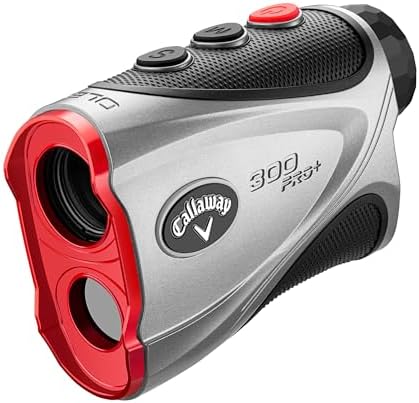
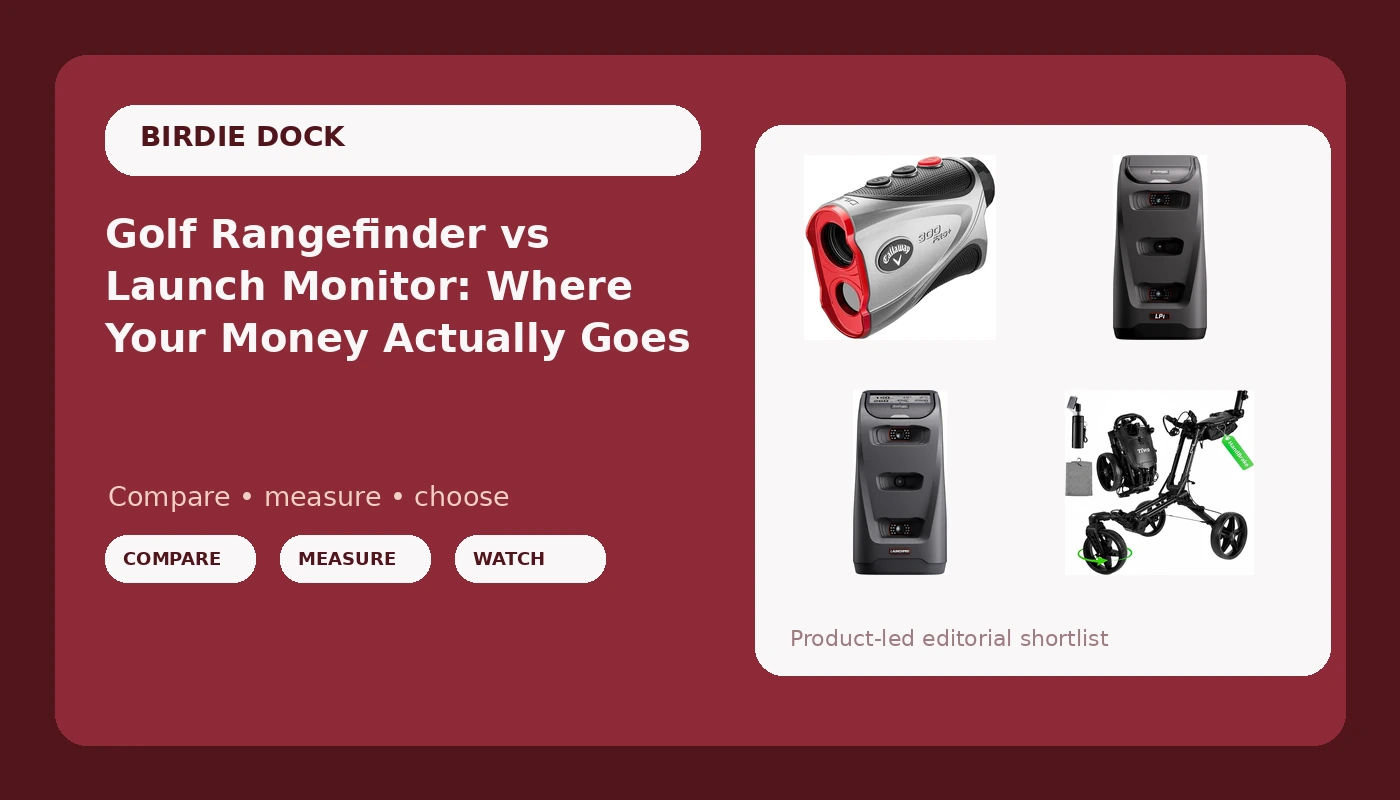
Callaway 300 Pro Golf Laser Rangefinder (with External Slope Switch)
The external slope switch is the honest feature here. Turn slope off for a tournament round, turn it back on for practice, and you get both jobs out of one unit
It answers exactly one question, the number to the flag. Ask it why the ball flew 140 instead of 155 and it has nothing to say
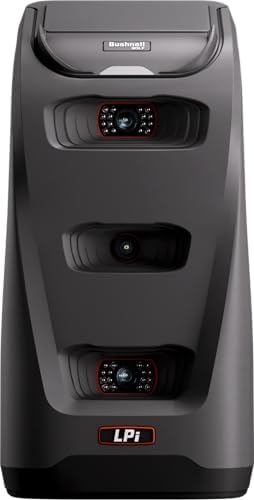
Bushnell Golf Launch Pro i - Circle B Edition Launch Monitor
This is the lower of the two Bushnell listings in this comparison, which makes it the sensible starting point if you want real ball flight data without jumping straight to the bigger number
It is still a four figure commitment. At this tier the purchase has to replace range sessions, not sit next to them
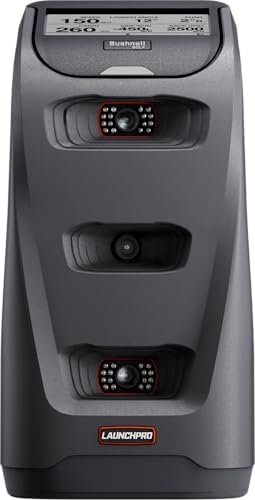
Bushnell Golf Launch Pro, Circle B Edition Launch Monitor
The step up listing for the player who already knows the data will get used every single week, indoors and out
You are paying more inside the same family name. If you cannot name what the extra money buys you, the cheaper Circle B edition is answering the same question
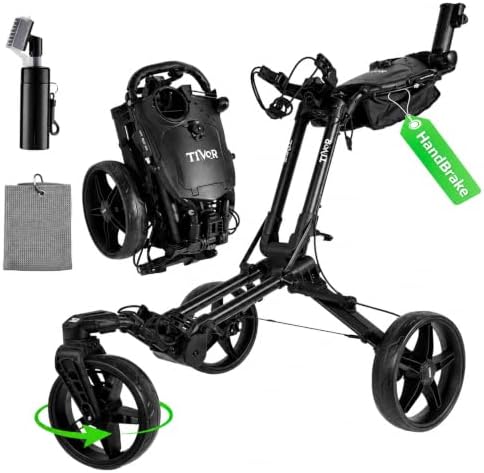
Tivor Golf Push Cart with 360° Front Wheels & Handbrake, 3 Wheel Pull Cart Offers One-Click Folding and All-Terrain Mobility
One click folding and 360° front wheels, which is the difference between walking eighteen holes and paying a cart fee every weekend
It does not lower your score by a stroke. It lowers how wrecked you feel at the turn, and some players will not pay for that
Prices and availability were captured from Amazon Creators API and may change.
How I judge gear like this
I do not write up gear I have not lived with, and I am not going to pretend I have owned four products that just landed on my desk. So treat this as the framework I use before I spend my own money, built from what these four products claim to be and the role each one plays in a bag or a garage. When a product does pass through my hands, it gets the same treatment every time: a spreadsheet with rounds played, months owned, and what broke first.
That last column is the one nobody markets. A rangefinder that loses its pin lock after a season in a cart basket is worth less than the one that still vibrates on the flag in year three. A launch monitor that needs a subscription to stay useful is not a $2,000 purchase, it is a $2,000 purchase plus a monthly bill, and that changes the math on the whole category.
My rule before any upgrade is simple. What does this do that the cheap option does not? If I cannot answer that out loud in one sentence, I do not buy it. That rule is why one of the two Bushnell listings in this comparison is a much easier recommendation than the other.
The rangefinder: Callaway 300 Pro
The Callaway 300 Pro Golf Laser Rangefinder is the least glamorous product in this table and the one I would buy first. The external slope switch is the part that matters, because slope compensation is the feature that gets rangefinders banned from tournament play when it cannot be switched off. Having the switch on the outside means you are not choosing between a legal unit and a helpful one.
What I would check before committing to any rangefinder, this one included: pin lock consistency at 150 and at 250, and whether the eye focus ring stays put. That focus ring is my single biggest pet peeve in this category. A ring that turns freely in your bag means you re-focus the thing every single time you pull it out, and after a month you stop pulling it out at all.
The honest limitation is scope. A rangefinder gives you a number, and a number only helps if you already know your stock yardages. If you do not know that your 7 iron carries 155, the rangefinder is telling you to hit a shot you cannot reliably hit. That is the gap the launch monitors fill, and it is the only real argument for spending ten times more.
The two Bushnell Circle B listings
Two Bushnell Golf Launch Pro Circle B Edition launch monitors in one comparison is unusual, and it is worth being blunt about why. On paper the difference between the Launch Pro i and the Launch Pro is a single letter in the name and a real gap in what you pay.
That gap is where my rule kicks in. If you are looking at the higher listing and you cannot finish this sentence, "I need this one because it does blank that the other one does not," then you are buying a name, not a capability. Buy the lower listing or buy neither and keep your money in your pocket for another season of greens fees.
What a launch monitor does for your game is genuinely different from what a rangefinder does. It tells you why. Carry distance, ball speed, launch, and the gap between your good swing and your bad one, measured instead of guessed. The players who get real value out of that are the ones already practicing two or three times a week and already keeping some kind of log. If your range sessions are thirty balls before a Saturday round, a launch monitor will produce numbers you never act on.
The cost of ownership question matters more here than anywhere else in golf. Before buying either Bushnell, price out what happens in year two and year three. Software, subscriptions, replacement parts, and whether the unit still works if the company changes its mind about the app. A launch monitor is a computer that happens to sit on a mat, and computers age faster than irons.
The push cart: Tivor
The Tivor Golf Push Cart is the product in this group I can recommend without a single caveat about your handicap. One click folding matters because the cart you actually use is the cart that goes from trunk to course in fifteen seconds. A cart that takes three minutes to assemble stays in the garage.
The 360° front wheels and the handbrake are the two features I would look for on any push cart. Front wheels that pivot freely make a three wheel cart behave on tight paths and side hills, and a handbrake is non negotiable if your course has any slope at all. If you have ever chased a cart down a hill with a bag full of clubs, you know exactly what that feature is worth.
The trade-off is honest: a push cart does not make you better. It makes walking eighteen holes possible when it was not before. If you are currently riding because your back, knees, or energy level will not take four hours on your feet with a bag on your shoulder, this is the single best dollar per round purchase in this entire comparison. Walking also tends to make you a more patient player, and patient players make better decisions on the 16th hole.
Where the money goes
If I were building a bag from this table, here is how I would split it.
The first tier is the walker's setup: the rangefinder plus the push cart. That is the combination that helps you on the course you actually play, every round, without a single app or subscription.
The second tier is the rangefinder plus the lower Bushnell listing. This is the practice player's setup. You get numbers on the course and numbers on the range, and you spend less than the step up listing.
The top tier is the higher Bushnell listing. That purchase only makes sense if you can point at the specific capability you are paying for, and if you are practicing enough that the data changes what you work on. If neither of those is true, the money is better spent on lessons and greens fees.
What I would check at month six
Here is what I would want to know about each of these after six months of real use, and what I would update in this article once I have it.
The rangefinder: whether pin lock still engages cleanly on a flag with a busy background, and whether the focus ring has drifted. The launch monitors: whether the unit still connects reliably, and what the software situation looks like after the first year. The push cart: whether the folding mechanism still snaps into place, and whether the wheels have developed any wobble.
Those are the failure points in each category, and they are the reason I do not treat a spec sheet as a review. A product is not proven on day one. It is proven on day two hundred, when the novelty has worn off and the thing still has to work.
Bottom line
Buy the rangefinder first. Buy the push cart if you want to walk and your body has been telling you to stop carrying. Buy the lower Bushnell listing if you practice seriously and want to know why the ball does what it does. Buy the higher Bushnell listing only when you can name the feature you are paying for without reading the box.
That is the whole test. What does it do that the cheap option does not, will it survive a season in the trunk, and would I still recommend it in six months. Answer those three and you will spend less and play better than the guy next to you with the full staff bag.