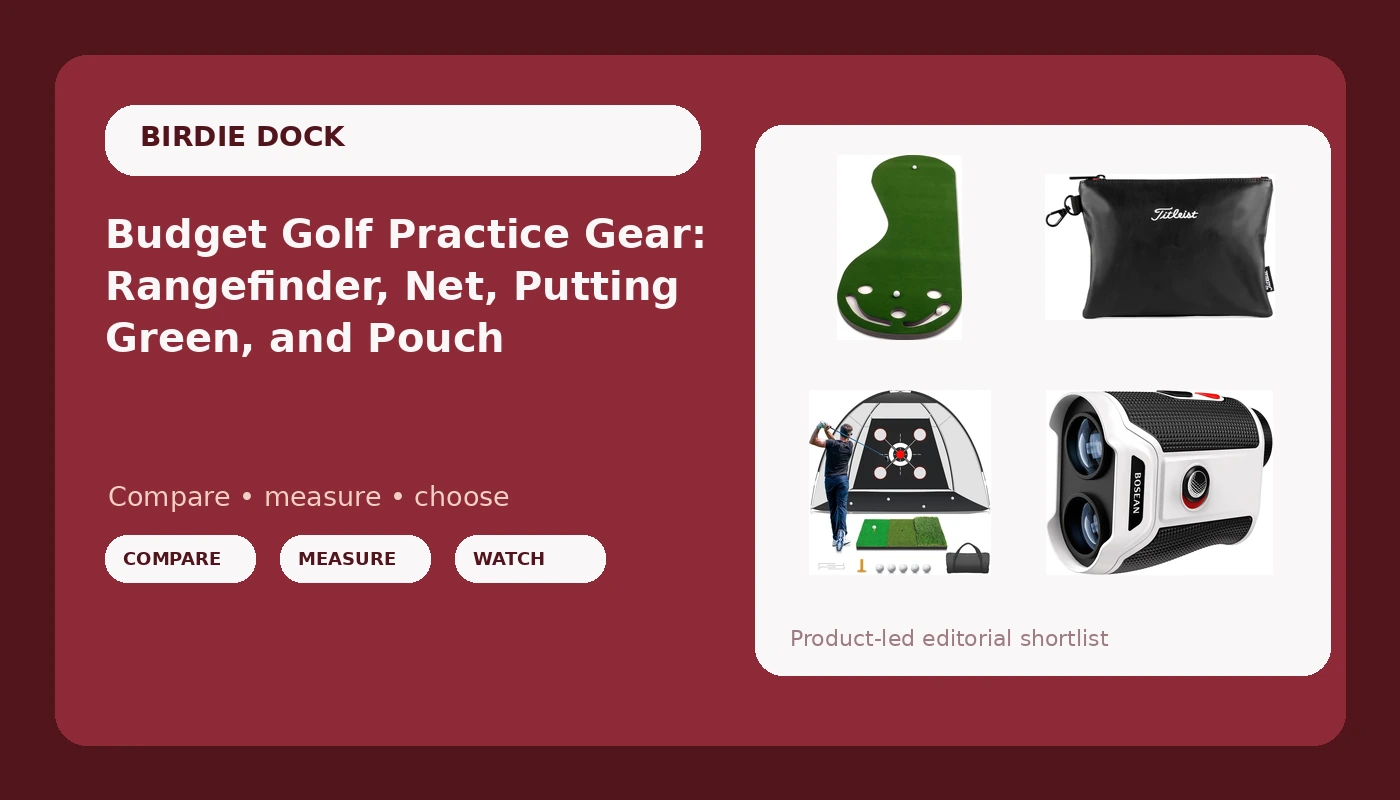
Budget golf practice gear gets marketed as if every item solves the same problem, and it does not. A rangefinder answers a question you ask standing in the fairway. A hitting net answers a question you ask in the backyard on a Tuesday night. A putting green answers a question you ask in a hallway in January. A pouch answers the question of where your tees went. If you are spending carefully, the useful move is to separate those jobs and buy the one that fixes the problem you actually have. This is a plain look at four pieces of budget golf practice gear, what each one is for, and what to check before you click.
Related: How to Build a Backyard Practice Setup That Survives Real Balls →
Quick answer
Four items, four jobs. A rangefinder with slope, magnetic mounting, and flag lock covers on-course distance. A 10 by 7 foot hitting net with an included mat covers full-swing and chipping reps at home. A 3 by 9 foot putting green covers indoor putting. A zippered pouch covers the small accessories that otherwise rattle around loose in a bag. If you can only add one this season, pick the one tied to the skill you practice least: distance control on the course, ball striking at home, or putting. None of these is a premium purchase, and none of them requires a fitting.
Four useful options
| Model | Best fit | What stands out |
|---|---|---|
| 1200 Yds Golf Range Finder with Slope, 7X Magnification Golf Rangefinder with Magnetic, FlagPole Lock Vibration, Rechargeable Golf Distance Finder for Hunting, Golf Accessories for Men Women | Players who want flag yardages without premium-brand pricing | Slope compensation, 7x magnification, magnetic body, flag lock vibration, rechargeable power |
| Golf Net with Practice Mat,Golf Hitting Aid Nets 10x7FT for Backyard Driving Chipping Training Swing with Target Mat Balls for Outdoor Indoor,Gifts for Men Dad Him and Golfer | Backyard full-swing and chipping reps | 10 by 7 foot net with a practice mat, target panel, and balls included |
| PUTT-A-BOUT Par Three Golf Putting Green (3' x 9') | Indoor putting in a hallway, office, or garage | 3 by 9 foot footprint that allows a real putting stroke rather than a tap |
| Titleist Travel Gear Professional Zippered Golf Pouch Black | Keeping tees, balls, markers, and a repair tool in one place | Zippered closure on a small travel-format pouch |
The distance tool: 1200 Yds Golf Range Finder with Slope
A rangefinder is the one item here that changes decisions during a round rather than between rounds. The features that matter are narrower than the marketing suggests. Magnification around 6x to 7x is the practical sweet spot: enough to isolate a flag at 200 yards, not so much that your hands have to be perfectly still. Flag lock is the feature that separates a usable unit from a frustrating one, and vibration feedback is the version you can feel when the pin is hard to see. Slope compensation adjusts the number for uphill and downhill shots, which is genuinely useful in casual play and not permitted in rounds where slope must be disabled, so check whether the slope function can be switched off before you plan on using it for a tournament or a handicap round. Rechargeable power is a quiet advantage because it removes the hunt for a coin cell in your bag. The magnetic body is a small convenience that matters more than it sounds: it lets you stick the unit to a cart frame instead of setting it in the grass or on the seat, where they get left behind.
The backyard build: Golf Net with Practice Mat
A net is the highest-rep item on this list and also the one most likely to fail early, which is why the bundle matters. Buying the net, mat, and target together usually costs less than assembling them separately, and it means you can start hitting the day it arrives. The trade-off is that bundled mats are typically the weakest part of any kit, because the mat takes the club's leading edge and your stance weight on every single swing while the net only takes the ball. Expect to inspect the mat first and the netting second. If the netting does wear, look at whether replacement panels are sold before you assume you need a whole new frame.
The indoor green: PUTT-A-BOUT Par Three Golf Putting Green (3' x 9')
Putting is where cheap practice pays off fastest, because the skill is speed control and start line, and both respond to repetition. Nine feet is the number to pay attention to here. Shorter mats train a stroke that is too short for real greens, and they hide the deceleration that costs you three-putts. Three feet of width is also worth noting: it is enough that a slightly off-line putt still stays on the surface, which keeps practice from turning into a ball-retrieval session. The practical question with any indoor green is where it lives. A hallway, a garage bay, or the space beside a desk all work, and the constraint is almost always length rather than width.
The bag organizer: Titleist Travel Gear Professional Zippered Golf Pouch Black
This is the least glamorous item on the list and the one you will touch the most. Tees, ball markers, a divot repair tool, a spare glove, and a couple of loose balls all fit in a pouch, and keeping them in one zippered container means you stop digging through the ball pocket with cold hands. A pouch also protects the inside of a bag from the pointy end of a repair tool, which is the kind of damage nobody notices until the lining is torn. If you already carry a valuables pocket, this is not urgent. If your bag sounds like a maraca when you walk, it is.
Prices and availability may change. Product images, names, and retailer links are matched to verified listings. No current price, rating, stock status, or measured result is stated here without current evidence.
How to read a rangefinder listing without getting fooled
The stated maximum range on a rangefinder is a marketing number measured under ideal conditions, usually against a large reflective target rather than a flagstick. What matters for golf is performance at the distances you actually face, roughly 50 to 250 yards, and how reliably the unit locks a pin against a background of trees or a bunker lip. Look for flag lock as a named feature and for a form of confirmation you can perceive, whether that is vibration, an audible tone, or a visual indicator. Vibration is the most useful in bright sun and wind because you feel it rather than look for it.
Magnification is the second thing to check. Under 6x and the flag at 180 yards is a guess. Over 8x and hand shake gets amplified to the point where you need a brace or a cart to hold steady. Seven times is a reasonable middle.
Battery design is the third. A rechargeable unit with a USB cable means you charge it like a phone and never think about it, while a unit that runs on a coin cell means buying spares and keeping one in the bag. Neither is wrong, but rechargeable is simpler if you remember to top it up before a round.
Slope is the fourth, and it is the one people get wrong. Slope compensation adjusts the raw yardage for elevation change, which is helpful for club selection. Many tournament and handicap rounds do not permit slope functionality, so the question to answer before buying is whether the slope feature can be turned off or whether the unit displays slope-only numbers with no way to disable it. Check the listing language carefully on that point.
Finally, consider the mount and the housing. A magnetic body lets you park the unit on a cart frame between shots, which reduces the odds of leaving it on the ground near the last green you played.
What separates a hitting net that lasts from one that does not
Netting fails at seams, at the center of the target panel, and at whatever point takes the highest ball speed. The frame usually outlives the netting, and the mat usually wears out before either of them. That gives you a reasonable expectation of what to check.
- Know your real ball speed before you trust a rating. A net rated for a number far above your actual speed has margin built in, and margin is what keeps a shank from finding your neighbor's fence.
- Compare the stated rating to your driver speed, not your wedge speed, and leave room. The rating is a ceiling, not a target.
- Add a second layer of padding behind the target panel. Hanging a blanket or a foam pad behind the strike zone spreads the load and gives the netting something to absorb into.
- Inspect the mat before the net. Check the stance area and the leading edge where irons dig in. A mat that bunches or slides is a safety issue, not just a comfort one.
- Re-check seams and anchor points at week three and again at month six. Anchor the frame with weight or stakes so a mis-hit does not walk the whole structure backward.
Setting up a practice corner you will actually use
- Pick the location based on how often you will walk to it, not on how much space it has. A nine foot green in a hallway beats a bigger setup in a garage you never open.
- Match the practice to the miss. If you lose strokes off the tee, the net earns its space first. If you lose them on the greens, the putting green does.
- Keep a small hitting station organized: pouch for tees and markers, mat squared to the target, net anchored, and nothing valuable behind the strike zone.
- Set a rep count you can finish in fifteen minutes. Short sessions that happen five days a week beat one long session you skip.
- Log what you work on. Yardages you trust and reps you completed are the only numbers that carry from one round to the next.
Which option should you choose?
Choose the 1200 Yds Golf Range Finder with Slope when your problem is not knowing the number, since that is a decision you make on every approach shot. Choose the Golf Net with Practice Mat when you want to hit real balls at home and you need the mat and target in the same box. Choose the PUTT-A-BOUT Par Three Golf Putting Green (3' x 9') when your scoring leaks on the greens and you have a hallway or garage bay to spare. Choose the Titleist Travel Gear Professional Zippered Golf Pouch Black when your bag has become a loose pile of accessories and you want one zippered home for all of it.
A caveat on evidence: none of these listings can be judged by a spec sheet alone. Stated range, netting ratings, and material descriptions come from the manufacturer, and long-term durability depends on your ball speed, your surface, and how often you actually use the gear. Treat the features above as the things worth verifying and treat the listed specifications as claims to check rather than results to assume.
The bottom line
Budget golf practice gear works when you buy for a specific job instead of buying a category. A rangefinder with slope and flag lock gives you better information on the course. A net with a mat and target gives you a place to make swings without a tee time. A nine foot putting green gives you reps through the winter. A zippered pouch keeps the whole operation from dissolving into loose tees. Start with the one tied to the shot that costs you the most strokes, check the listing for the specific features that matter, and let the gear prove itself over a season rather than a weekend.