Most golfers I know do not need another club. They need twenty minutes of practice that actually happens, and they need the tools for it to cost less than a round. That is the whole case for budget golf training aids: simple, single-purpose gear that gives you feedback on the three things amateurs get wrong before the ball is even moving, which are grip, aim, and contact. The catch is that the inexpensive end of the practice aisle is crowded with gear that photographs well and dies by August. So the useful question is not which aid costs the least. It is which one you will still be pulling out of the bag next season.
Related: Practice Gear That Survives a Full Season of Real Balls →
Quick answer
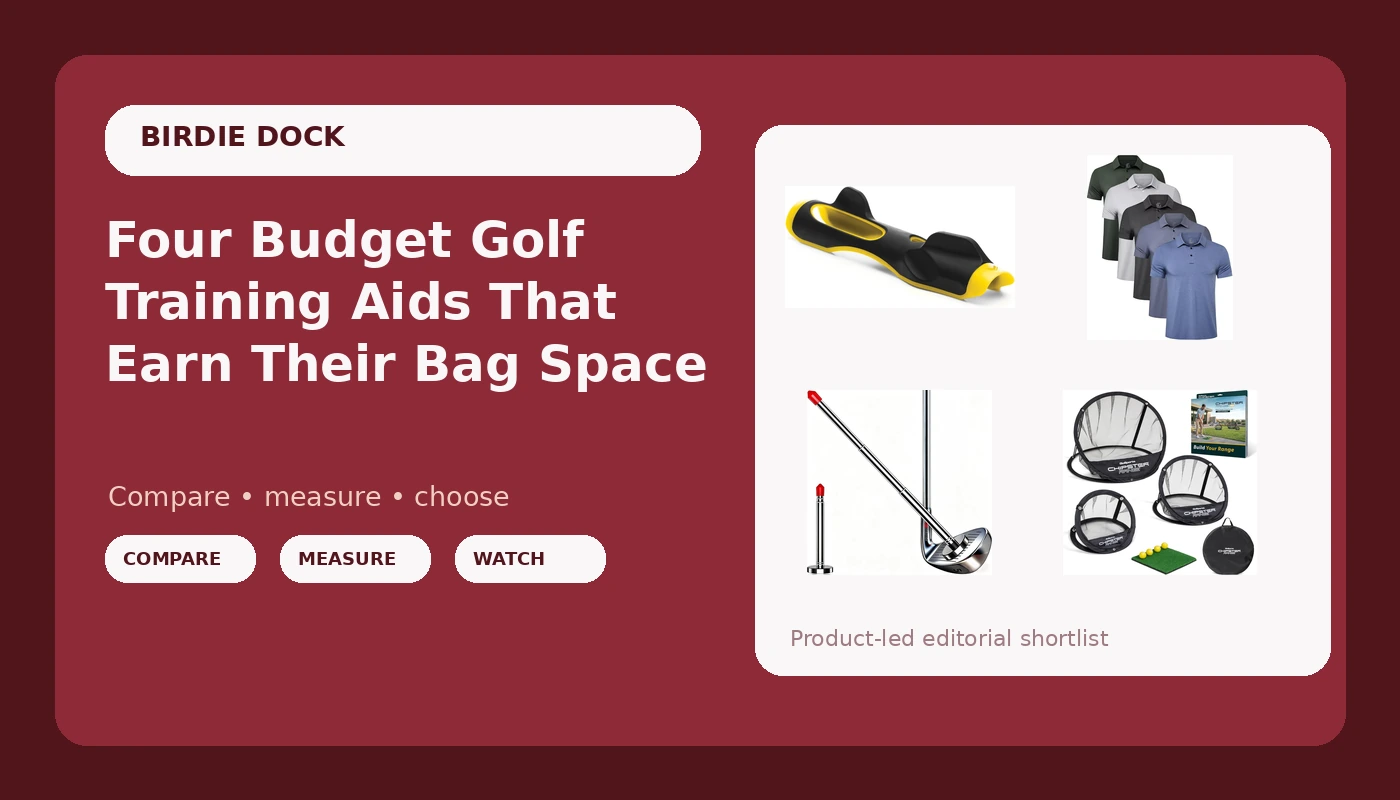
Three tools cover the fundamentals: something that puts your hands in the same place every time, something that shows you where you are actually aimed, and something that lets you hit short shots without driving to a range. The SKLZ Golf Grip Trainer covers the first, the telescoping Golf Alignment Rods cover the second, and the GoSports Chipster Range PRO covers the third. The five-pack of men's polo shirts is the odd one out, and it earns its place for a different reason: it removes a small daily friction from playing and practicing, which matters more than most golfers admit.
4 useful options
| Model | Best fit | What stands out |
|---|---|---|
| SKLZ Golf Grip Trainer | Rehearsing hand position before a round or range session | Attaches to a standard grip and fits driver through wedge, right-handed |
| Golf Alignment Rods | Checking aim, ball position, and swing path | Telescoping sections with a magnetic connection for setup and storage |
| GoSports Chipster Range PRO Golf Chipping Nets | Chipping and pitching in a yard, garage, or driveway | Comes as a set with a hitting mat and four foam balls |
| 5 Pack Men's Polo Shirts | Round-day and range-day shirts without buying one at a time | Five shirts per pack, moisture wicking, tagless, quick dry |
The grip fixer: SKLZ Golf Grip Trainer
Grip is the cheapest thing in golf to change and the hardest thing to actually change, because your hands return to whatever feels normal once the pressure is on. A grip trainer works by making the wrong position feel wrong during practice, which is the only way that habit breaks. What it will not do is fix a slice by itself, because a slice is usually a face and path problem rather than a hand position problem. Treat it as a checkpoint: two minutes at the start of a session, then hit balls with the same feel and watch the ball flight.
The aim checker: Golf Alignment Rods
The classic use is two rods: one along your toe line, one just outside the ball pointing at your target. If the second rod looks like it is aimed at the trees while you feel aimed at the flag, you have just found a stroke without touching your swing. Telescoping rods are a compromise. They are lighter and shorter than dedicated full-length sticks, so they can shift if you bump them, and they are easier to misplace in tall grass. For most players that trade is worth it, because the rods that actually make it to the range are the ones that fit in the bag.
The short game station: GoSports Chipster Range PRO Golf Chipping Nets
Here is the honest trade-off. Foam balls are safe indoors and they let you rehearse contact without breaking a window, but they do not tell you much about how a real ball behaves off the face, and they will not stress the target. If your plan is to hit real golf balls, check the manufacturer's stated limits first and understand that a chipping net is built for short shots, not driver swings. If your plan is twenty chips a night in the garage, this is the kind of setup that makes it possible, and the mat matters as much as the net because it protects your floors and gives you a consistent lie.
The round-day layer: 5 Pack Men's Polo Shirts
Sizing is the thing to get right here, and it is the thing listings are worst at. Pack polos tend to run to a generic fit, so measure a polo you already like across the chest and compare that number to the size chart instead of trusting your usual letter size. If you are tall or broad through the shoulders, size up and expect to use the extra length when you bend over a putt. The real upside of a pack is that you stop rationing your good shirts, which means you stop skipping the range session because everything decent is in the laundry.
Prices and availability may change. Check the current price and availability on Amazon before buying. Product details, included items, and manufacturer specifications can change without notice.
What a training aid can and cannot fix
Training aids are feedback devices. They do not create a swing, they reveal one. That distinction matters, because the practice aisle is full of products that promise to fix a problem the buyer has not actually diagnosed.
The three things worth buying feedback on are grip, aim, and low-point control. Grip is the interface between you and the club, and it is the easiest thing to rehearse without hitting a ball. Aim is the most commonly wrong element in amateur golf and the cheapest to correct, because a couple of rods cost almost nothing. Low-point control is what chipping practice builds: knowing where the club bottoms out and being able to repeat it.
What no aid can do is tell you why the ball curves. A grip trainer cannot fix an open face at impact. Alignment rods cannot fix an over-the-top move. A chipping net cannot teach you a proper pivot. Those are swing problems, and the honest path is a lesson or a video review, followed by practice with the tools above to make the change stick. Buy the aid that supports the work you are already doing, not the aid that promises to skip it.
How to judge practice gear before you spend
Cheap practice gear fails in predictable ways, and you can usually spot the failure mode in the listing if you know what to look for. Nets fail at the seams and at the target. Mats fail at the edge where you stand. Telescoping rods fail at the locking joint. Pack apparel fails at the seams and the collar.
The fix is to decide in advance what you will do when the weak point shows up. If a mat is replaceable and the net is not, the net is the purchase. If a rod set is inexpensive enough to buy twice, the locking joint matters less. If a pack of shirts costs less than two shirts from a brand name, a shorter lifespan is a reasonable trade as long as the fabric does what the listing says it does.
Then track it. Write down the date you started using something and check in at three weeks and six months. That habit is boring, and it is the only way to know whether the cheap option was a genuine bargain or just a delay.
- Write down the one shot you lose the most strokes to, and buy only the aid that gives feedback on it.
- Decide whether you will practice indoors or outdoors, because that determines whether foam balls and a mat are required.
- Identify what is replaceable. Mats, foam balls, and lanyards are consumables. Nets and rods are not.
- Read the stated limits and intended use, then stay inside them instead of assuming the product is stronger than the listing says.
- Log the start date and re-check at three weeks and six months before recommending the product to anyone, including yourself.
Setting up a practice corner that actually gets used
- Put the chipping target somewhere you walk past daily, not in a closet.
- Keep the grip trainer on a club you actually swing, so it gets used during warm-ups.
- Store the alignment rods in the bag, not the garage, so they travel to the range.
- Set a repeatable session length, even if it is only ten minutes.
- Keep one shirt and one towel designated for practice so laundry never becomes the excuse.
Which option should you choose?
Choose the SKLZ Golf Grip Trainer when your grip changes from round to round and you want a physical checkpoint you can rehearse in a few minutes. Choose the Golf Alignment Rods when you suspect you are aimed somewhere other than where you think you are aimed, which describes most golfers. Choose the GoSports Chipster Range PRO Golf Chipping Nets when your practice space is a yard, a garage, or a driveway and you want to hit short shots without a range trip. Choose the 5 Pack Men's Polo Shirts when the thing standing between you and more practice is laundry and heat rather than technique.
One caveat applies to all four: none of these replace a lesson, a fitting, or a launch monitor session, and none of them are premium tools. They are inexpensive aids with narrow jobs, and they are worth buying only if you will use them. Treat the stated limits on any net or target as a ceiling rather than a suggestion, and confirm the included items before you order.
The bottom line
Practice gear earns its place the same way a club does: by surviving a season and still getting used. Grip, aim, and short game contact are the three cheapest things to improve, and they are the three things a small set of budget golf training aids can actually give you feedback on. Start with the one that matches the shot you lose the most strokes to, add the others only once the first one is part of your routine, and re-evaluate everything at the six-month mark. The polo pack is the only item here that has nothing to do with your swing, and it still matters, because the easiest practice session to skip is the one you talk yourself out of.