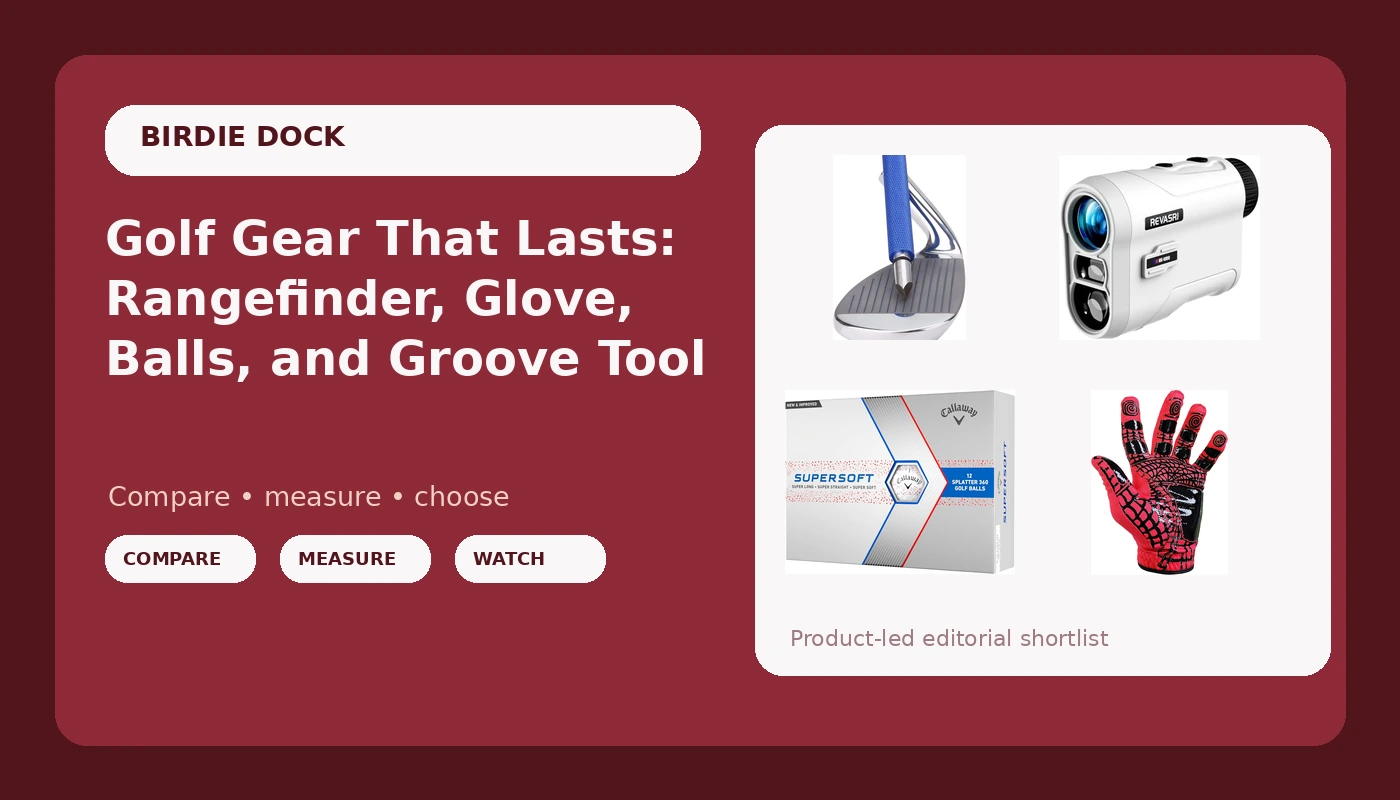
Most golfers do not lose strokes because their gear is not expensive enough. They lose strokes because their wedge grooves are packed with dirt and no longer bite, their glove is slick by the back nine, they are pacing off yardages to a sprinkler head, and they are playing a ball that does not match how they swing. The golf gear that lasts in a real bag is almost never the gear with the biggest logo on it. It is the rangefinder that locks the flag the first time you pull it out, the groove tool that still cuts a clean edge after a full season, the glove that keeps its tack when your hand is sweating in July, and the ball you can afford to lose without flinching.
That is the idea behind this guide: four pieces of golf gear that last, chosen because each one solves a problem you actually have on the course rather than a problem the marketing department invented. Two of them cost less than a dozen premium balls. One replaces a job you would otherwise hand to a repair bench. And one is the ball most players should default to when they are not chasing a specific launch window on a monitor.
Related: How to Dial In Your Distances Without a Fitting →
Quick answer
The gear that moves your score most per dollar is the cheap, high-use stuff: something that gives you a real number to the flag, something that keeps your grooves clean, something that keeps the club attached to your hands, and a ball that suits your swing. None of those four jobs require premium pricing. The options below cover yardage, contact, grip, and ball, and each one earns its spot on function rather than badge.
Four useful options
| Model | Best fit | What stands out |
|---|---|---|
| REVASRI Range Finder for Golf, Slope, Pin Lock Vibration 1000Y Rangefinder | Players who want slope and pin lock without paying for a brand name | 6.5X magnification, pin lock vibration, external slope switch, rechargeable |
| Bulex Golf Club Groove Sharpener | Anyone whose wedges and irons have stopped biting | Works on both U-grooves and V-grooves, cleans and regrooves in one tool |
| MONKEY GRIP Ultra Silicon Golf Glove Red Spider Grip Left Hand | Sweaty hands and players fighting a twisting grip | Synthetic tacky palm, anti-slice no-twist fit, breathable build |
| Callaway Golf Supersoft Golf Balls (2023) | Mid and higher handicaps who want soft feel without a premium ball price | Soft feel, mainstream 2023 model, easy to restock |
The yardage pick: REVASRI Range Finder for Golf
I have spent the last six months bouncing a budget rangefinder around my bag and checking it against a friend's premium unit on the same flags every weekend. Same number, both times. The lesson is not that the expensive unit is bad. It is that the feature you are paying for at the top of the market is glass quality, housing feel, and brand history, not a different distance. The slope question matters more than the badge. If your league or club championship treats slope as illegal, an external switch is the difference between a legal unit and a unit you have to leave in the car.
The trade-off here is durability feel. A rangefinder at this end of the market will not have the same armored housing as a flagship, so it lives in a pocket rather than loose in the bag next to your irons. Treat it like a lens, not like a wrench, and it will outlast the season.
The maintenance pick: Bulex Golf Club Groove Sharpener
Be honest about what a groove tool can and cannot do. It cannot add spin to a face that is already at the legal limit, and the manufacturer's claim about generating optimal backspin is about restoring what wear and dirt took away, not about exceeding a new club. What it can do is keep a wedge you already like performing the way it did when you bought it, which is worth more than another wedge purchase for most players.
The trade-off is technique. A regrooving tool used carelessly will cut metal you did not mean to cut, so work along the groove line with light pressure and clean the face first. If you are unsure, practice on an old iron from the garage before you touch your gamer wedge.
The grip pick: MONKEY GRIP Ultra Silicon Golf Glove Red Spider Grip Left Hand
The anti-slice language in the listing deserves a plain translation: a glove does not fix a slice. What a no-twist fit does is remove one variable, the glove rotating or bunching under your lead hand, which can leave the face a degree or two open at impact. That is a real effect and a small one. Buy the glove for the tack and the fit, and treat the anti-slice wording as marketing.
The trade-off is fit dependency. Gloves are the least forgiving purchase in golf because a poor fit ruins a good material. Measure your hand rather than guessing, and if you are between sizes, take the smaller one for a synthetic palm, since these materials stretch with sweat and heat.
The ball: Callaway Golf Supersoft Golf Balls (2023)
The ball is the piece of gear players overthink most and change least usefully. A tour-level urethane ball is a genuine tool for a player who can control spin and trajectory, and a liability for a player who loses three a round to the same pull hook. The trade-off with a soft-feel ball is spin around the greens: you give up some bite for a softer feel and a friendlier price per ball. If your short game depends on stopping the ball on firm greens, that trade is real and you should think about it before you commit to a season.
Prices and availability may change. Product images, names, and retailer links must be matched by verified ASIN. Do not state a current price, rating, stock status, or measured result without current evidence.
What premium actually buys you in golf gear
I spent six years behind a counter in a big-box golf shop, fitting clubs and doing repair work, and the markup math is the part that never leaves you. Premium golf gear is not a scam. It is a bundle of real costs: tighter manufacturing tolerances, better glass and coatings, more expensive housings, warranty support, dealer margin, and the marketing that got you into the store. What it is not is a guarantee of a better result.
The separation between price and performance is widest in the fitting tier. A launch monitor, a custom shaft build, a putter fitting with a real fitter on a real green: those cost money and produce measurable differences for the right player. The separation is narrowest in the accessory tier. A groove brush, a glove, a rangefinder with a pin lock, and a ball: these are solved problems, and the cheap version of a solved problem usually works.
That gives you a simple test before any purchase. Ask what the item does that the cheapest functional version does not. If the honest answer is "feels nicer" or "looks better in the bag," that is fine, as long as you are paying for it on purpose. If the honest answer is "nothing I can name," you just saved yourself the money.
How to judge a piece of golf gear before you buy it
Run every purchase through the same five questions, and you will stop buying gear you replace in a year.
- What does this do that the cheapest functional option does not? If you cannot answer in one sentence, the upgrade is cosmetic.
- What breaks first on this item, and can I replace that part cheaply? Straps, lanyards, batteries, and mats fail long before the core product does.
- Is it a consumable or a tool? Consumables you buy in twos. Tools you buy once and maintain.
- Does it pass the rules question? Slope rangefinders, groove condition, and ball conformance all have a competition answer, and you want it before you buy, not on the first tee.
- Would I still recommend this after a season of real use? Write your week-three opinion down somewhere. Revisit it at month six. That gap is where honest reviews live.
Keeping this gear alive for a full season
- Clean your grooves after every round, not every month. Dirt packed in a groove is spin you are leaving on the face.
- Store the rangefinder in a pocket, not loose in the bag, and clean the lens with water and a microfiber rather than your shirt.
- Rotate two gloves so each one dries completely between rounds. Gloves die from moisture, not from swings.
- Buy the cheap stuff in twos. A second groove tool or glove costs less than the shipping you will pay when the first one wears out mid-season.
- Write the purchase date on the item or in a note on your phone. You cannot judge durability without a starting point.
Which option should you choose?
Choose the REVASRI Range Finder for Golf, Slope, Pin Lock Vibration 1000Y Rangefinder when you want a real number to the flag, slope correction on practice rounds, and a physical switch that keeps the unit legal when it needs to be. Choose the Bulex Golf Club Groove Sharpener when your wedges have stopped biting and you would rather restore the face than replace the club. Choose the MONKEY GRIP Ultra Silicon Golf Glove Red Spider Grip Left Hand when your current glove is slick by the turn and you want a tacky synthetic palm that resists twisting on the grip. Choose the Callaway Golf Supersoft Golf Balls (2023) when you want a soft-feel ball you can put in play for a full season without dreading the water.
There is a limit to what any buying guide can tell you. None of these products has been tested by me on a launch monitor, and none of the claims here rest on measured data from my own rounds. What this guide can do is tell you what each item is for, what it does not do, and where the trade-offs sit, so you can match it to your game instead of to a shelf display.
The bottom line
The golf gear that lasts is rarely the gear that costs the most. It is the rangefinder that locks the pin every time, the groove tool that keeps your wedges biting, the glove that stays tacky through a humid round, and the ball you can lose without it ruining your day. Those four jobs are the ones that show up on your scorecard every round, and none of them require premium pricing to get done. Start with the cheap, high-use items, track how long they last, and let the durability record, not the logo, decide what stays in the bag.